演講報告:Geoff Mulgan 談改變自己與改變世界
本講演記錄Geoff Mulgan對內在與社會變革的主張,並提供理解幸福、智慧、想像力與多重自我的框架。
- 活動
- 搞「雜」世界的我,踏上了搞雜人生之旅 (TIES 2021)
- 日期
- 2021-06-30
- 作者
- 智庫報告(機器草稿,未校閱)
- 原發表處
- Recording on YouTube
- 存檔日期
- 2026-11-21
- 活動
- 搞「雜」世界的我,踏上了搞雜人生之旅 (TIES 2021)
- 日期
- 2021-06-30
- 作者
- 智庫報告(機器草稿,未校閱)
- 原發表處
- Recording on YouTube
- 存檔日期
- 2026-11-21
目錄
Sir Geoff Mulgan spoke at the 2021 Taiwan International Education Summit (TIES), “The Inner and Inter-Changes of Creative Changemakers,” during Section 4, “SOCIALpath: Tides and Ties of the Collectives,” on 30 June 2021. Introduced by summit curator and host Adler Yang as the section’s Western-perspective speaker, Mulgan argued that inner and outer change should not be treated as alternatives: individuals and societies must work on both, while accepting the continuing tension between them.
The tension between changing oneself and changing the world
Yang introduced Mulgan as Professor of Collective Intelligence, Public Policy and Social Innovation at University College London and founder of Demos. He asked participants to consider why Mulgan placed confidence in collective intelligence despite longstanding fears about majorities and populism, and why individual consciousness remained important within collective processes commonly entrusted to institutions.
Mulgan described his career as divided between top-down work with governments and ground-up work with innovators, community activists and social entrepreneurs. He connected this experience to an encounter at age 17 with a Buddhist thinker in Sri Lanka [unclear in recording, 2:11:00]. Mulgan, then an angry political activist, maintained that urgent problems required changing the world. The thinker argued that people must first change themselves, because their actions would otherwise reproduce their inner pathologies.
Their disagreement continued for ten years. Looking back, Mulgan said that both positions were incomplete. Each person must determine a balance between inner and outer change, although the two will remain in tension. Climate change, for example, cannot be postponed until everyone has reached a state of personal transformation. (2:05:45–2:12:04)
Happiness as an alignment of personal and social well-being
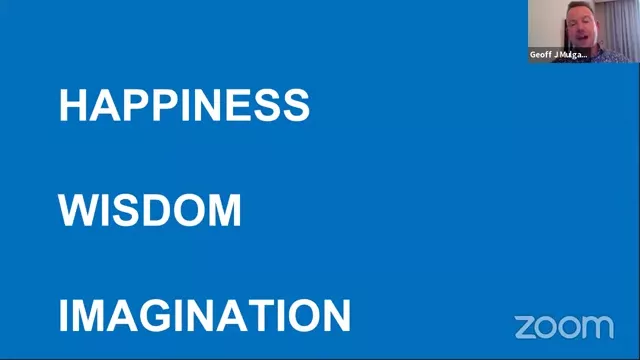
Mulgan’s first theme was happiness as one dimension of the inner world. He distinguished among actions people can take for their own happiness, actions that support those around them, and measures available to governments and businesses.
He discussed Action for Happiness, an organisation he helped establish, which had the Dalai Lama as its patron. Its recommendations drew together knowledge about thriving through such practices as making time for silence, engaging with nature and caring for other people. Its course, Exploring What Matters, had recently undergone a randomised controlled trial. Mulgan said the study found substantial effects on both happiness and social connectedness, raising the question of why such practices were not more widely incorporated into ordinary institutions.
The organisation was working with schools and universities to apply these methods, while one of Mulgan’s co-founders was preparing to oversee mental well-being across UK universities. Mulgan described the underlying approach as aligning outer and inner purpose: caring for oneself without treating well-being as an exclusively private or selfish pursuit. Personal well-being, he said, depends upon the well-being of others. Action for Happiness had well over one million social-media followers, nearly 300,000 formal members and groups around the world. Mulgan also noted that he was working with the Finnish government to incorporate happiness and well-being into public policy. (2:12:04–2:15:11)
Wisdom for an exponential era
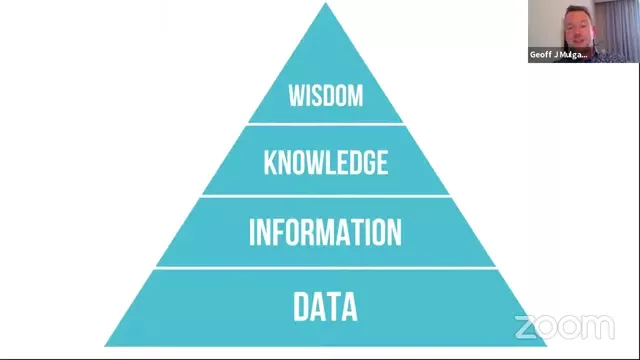
Mulgan’s second theme was wisdom. Population, GDP, resource use and resource depletion had all followed exponential trajectories over the preceding 200 years, but, he argued, societies had not developed “exponential wisdom” adequate to those conditions. Younger people often recognised that those in power lacked suitable mindsets, while political leaders and social-media systems could spread behaviour, lies and misinformation opposed to reflective wisdom.
Universities, once regarded as guardians of wisdom, now rarely taught it and were sometimes reluctant even to discuss it. Mulgan also questioned older conceptions centred on elderly men detached from the world and positioned within a hierarchy. Traditional wisdom literature, he said, did not necessarily help people respond to oppressive governments, everyday relationships, the COVID pandemic, unemployment or endangered species.
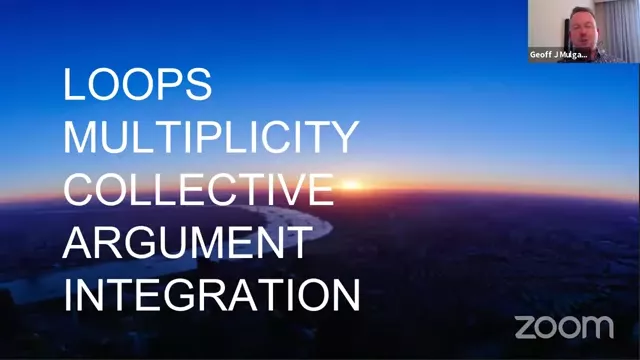
He outlined five elements of a more practical conception. The first was learning through loops: anticipating what will happen, observing what actually occurs and adjusting one’s beliefs. Although simple, this habit of doubt and revision was rare among individuals, governments and institutions. The second was multiplicity, since problems often require several perspectives rather than one linear view. The third was collective intelligence: under appropriate conditions, groups can solve problems better than even their cleverest individual member, though “crowds are not always wise” (2:18:21).
A fourth element was challenge. Participants must be willing to test arguments and state what they genuinely think rather than remaining excessively polite. The fifth was integration, bringing different perspectives together while applying an ethical lens. Mulgan described social wisdom as a kind of “dark matter”: societies possessing more of it manage conflicts and shocks more effectively, while those possessing less can allow small problems to escalate rapidly. (2:15:11–2:20:28)
Reawakening social imagination
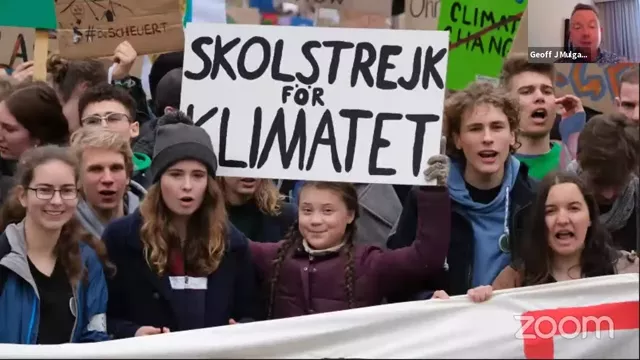
Mulgan then addressed imagination. Many younger people, particularly in Europe, could picture catastrophic climate futures involving rising temperatures, food shortages, refugee crises and widespread destruction. More positive images tended to be technological and impersonal: machines, pervasive data collection and systems with little visible place for human beings.
He contrasted those images with findings from the 2019 World Happiness Report, which he said showed that the best predictor of national happiness was whether people had friends and relatives they could rely upon in need. Technologies might produce many superficial connections without creating dependable relationships. Meanwhile, international surveys showed majorities of parents in numerous countries expecting their children to be worse off than they were, indicating a widespread loss of confidence in the future.
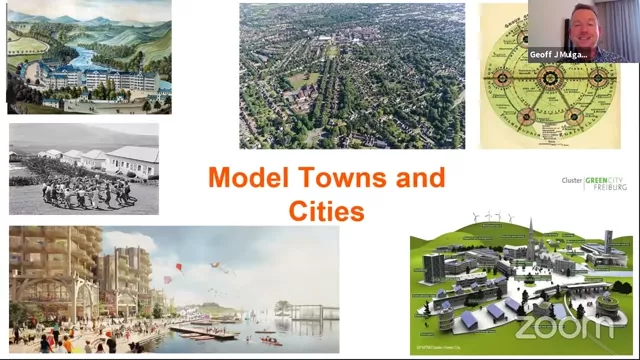
Mulgan outlined several means of rebuilding imagination: utopian literature, generative concepts such as the circular economy and universal basic income, model towns, speculative design, fiction and the arts. He said universal basic income was being trialled in dozens of countries, partly because of COVID, and could reduce anxiety while supporting employment. He also contrasted green cities and earlier garden-city models with Google’s failed attempt to create a data-driven model district in Toronto.
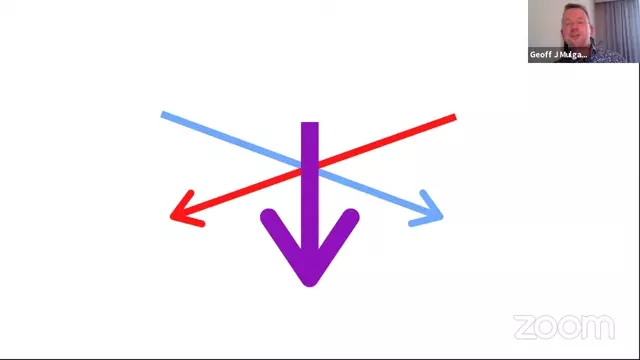
Looking ahead, Mulgan distinguished among following dominant technological trends, rejecting them entirely, and synthesising movement with and against those trends. Environmentalism, he said, had shifted from broad opposition to industry and technology toward developing alternatives such as meat substitutes and less damaging textile systems. He called this “dialectical imagination”: working simultaneously with and against prevailing currents. (2:20:28–2:28:51)
Containing multitudes
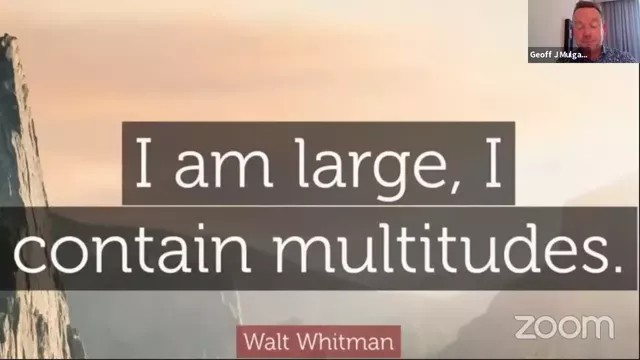

Mulgan returned to the relationship between inner and outer life through Walt Whitman’s phrase, “I am large, I contain multitudes” (2:29:53), also referenced in a recent Bob Dylan song. He rejected the expectation that each person should possess a singular, fully coherent self with fixed boundaries.
Instead, he proposed understanding the self as containing multiple elements or modules that may cooperate, compete, become dormant or engage at different times. People should therefore not expect perfect alignment between their inner and outer lives. They can hold different identities and roles, and personal growth may involve sustaining several parts of the self without becoming overly troubled by occasional contradictions among them. (2:28:51–2:30:56)
Discussion
Yang responded that the talk had revisited several themes raised elsewhere in the summit, including inner and outer worlds, multiple forms of selfhood, ecological awareness and regenerative cultures. He asked Mulgan whether he could remain for another 30 minutes. Mulgan agreed but said he preferred hearing participants’ views and responses to conducting a conventional Q&A.
Because the schedule had changed, Yang explained that speakers would rotate through three breakout groups in five-minute rounds. He also described a workbook process through which participants had shared their concerns, purposes and expectations before the talks, allowing common interests to emerge as topics for the breakout conversations. He noted that most participants were from Taiwan and might be hesitant about speaking English, while others had joined from countries including Sri Lanka and Canada. The excerpt ended as the organisers prepared to assign Mulgan and the other speakers to their first groups. (2:30:56–2:35:07)