演講報告:黃英琦談打造由下而上的社會變革生態系
本篇演講報告呈現Ada Wong如何以學校、青年計畫與公民平台建立由下而上的社會變革生態系。
- 活動
- 搞「雜」世界的我,踏上了搞雜人生之旅 (TIES 2021)
- 日期
- 2021-06-30
- 作者
- 智庫報告(機器草稿,未校閱)
- 原發表處
- Recording on YouTube
- 存檔日期
- 2026-11-22
- 活動
- 搞「雜」世界的我,踏上了搞雜人生之旅 (TIES 2021)
- 日期
- 2021-06-30
- 作者
- 智庫報告(機器草稿,未校閱)
- 原發表處
- Recording on YouTube
- 存檔日期
- 2026-11-22
目錄
Ada Wong spoke at the 2021 Taiwan International Education Summit, held online on 29–30 June 2021. Introduced by summit curator and session host Adler Yang, her “Eastern perspective” talk formed part of Section 4, “SOCIALpath: Tides and Ties of the Collectives,” on 30 June. Wong argued that social change requires a bottom-up ecosystem in which schools, young people and civil-society organisations develop the capacity to act, collaborate across sectors and influence public decisions.
Building an ecosystem from below
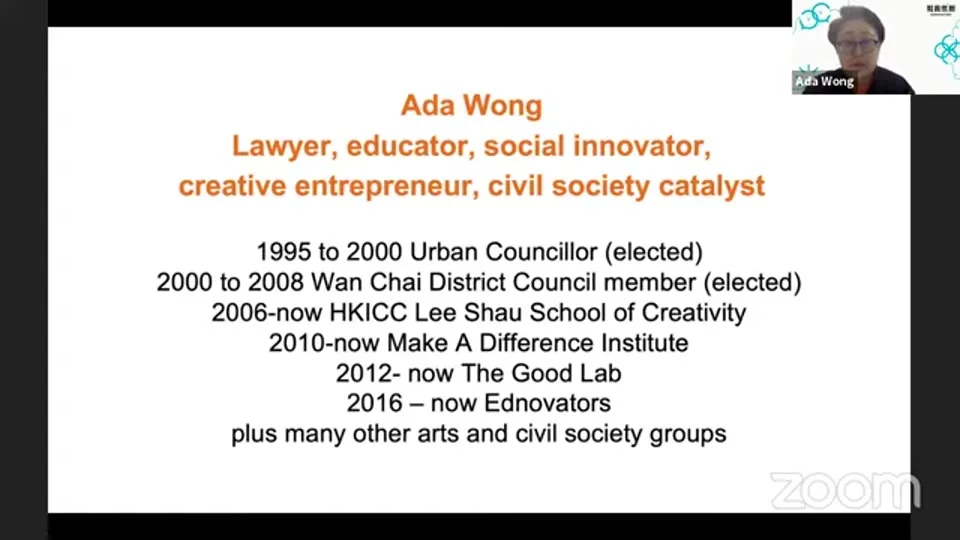
Wong asked the audience to consider not only what she had created during the preceding 20 to 25 years, but why and how she had done so. She described herself as a lawyer, educator, social innovator, creative entrepreneur and, principally, a “civil society catalyst” who starts initiatives that may grow into a diverse ecosystem.
Her 14 years in elected office, on the Urban Council and District Council, had shown her that government alone was neither sufficient nor responsive enough to address social issues or introduce new perspectives. She consequently asked how citizens could create change themselves. Such change, she said, should begin with individuals and proceed from the bottom up.
Wong organised the talk around three institutions she had helped build: the HKICC Lee Shau Kee School of Creativity, MaD and The Good Lab. These organisations represented parallel strands of her career rather than successive stages. She compared this combination to the multiple occupations sometimes described as a “slash” career, calling herself “an old slash.” (0:26:51–0:32:31)
An alternative school centred on creativity
Wong presented the HKICC Lee Shau Kee School of Creativity as an alternative senior secondary school founded to provide a humanistic response to students’ needs and nurture creative talent. After beginning in a borrowed one-storey campus, it moved into a new building in its second year. Its curriculum centres on art, culture and design, while its stated aims include helping students discover themselves, the world and knowledge.
The school values imagination, innovation and compassion, which Wong considered particularly important in the age of artificial intelligence. It also emphasises difference, inclusion and autonomy. Students receive space to set their own learning pace and take ownership of their education, although outsiders may interpret this freedom as insufficient discipline.
Teachers and students learn together in relatively equal settings, often sitting in circles. The campus hosts exhibitions, performances, band and fashion shows, an annual book fair and a sports day combined with cosplay, an event devised by students. The school does not organise learning around punishment or expulsion for examination failure. Its principles instead include care for people and things, respect for individual and collective rights and obligations, and openness towards differences.
Alongside Chinese, English and mathematics, students undertake inquiry-based and experiential learning across music, visual arts, design technology, film and video, performing arts and spatial studies. They can complete the school’s own diploma in creative arts rather than the Hong Kong Diploma of Secondary Education. Community learning, collaboration with artists and cultural groups, and civic participation are also part of the programme.
Wong noted that the school had existed for 15 years but remained the only institution of its kind in Hong Kong. This led her to question whether its uniqueness represented success, since she had expected more educators to establish alternative or experimental schools. Nevertheless, she said its presence had shown parents that educational change was possible. From September 2021, it would extend its provision to students from the age of 12. (0:32:32–0:44:02)
MaD programmes in schools and communities
Wong said MaD initially organised a three-day annual event resembling TED Talks. Attended by 1,500 people, it brought international innovators and thought leaders together with young people, including participants from Taiwan. Between 2010 and about 2018, it helped form an Asian network of young people who regarded themselves as potential leaders of social change. As similar events proliferated and large international gatherings remained costly, MaD shifted towards smaller interventions intended to produce deeper ecosystem change.
Through MaD School, developed with The Hong Kong Jockey Club Charities Trust, primary-school students learned to study sites and users, experiment with materials and construct play spaces from inexpensive and recycled materials. Another programme, “Sage Trees,” brought arborists, artists, writers, teachers and a food journalist into a secondary school. Students researched nearby trees, produced artworks and created an online tree map of their neighbourhood.
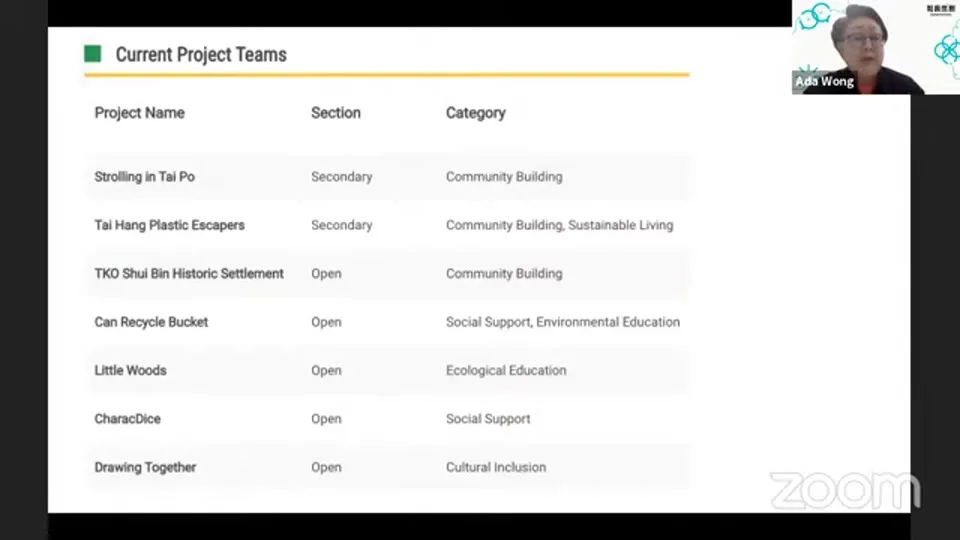
A community cookbook project asked students to interview parents and grandparents and record their families’ histories through food. MaD Incubator, meanwhile, offered secondary-school teams six months of workshops, neighbourhood observation, mentoring and project development. Each team received about HK$8,000—approximately NT$30,000—to test responses to community problems, including recycling drink cans and reducing plastic food-delivery containers. The resulting projects were presented publicly alongside the school-based programmes. (0:44:03–0:53:20)
Experiments in place, policy and inclusion
During the pandemic, MaD replaced an intended overseas learning trip with “Cities for Play,” giving participants a map of play spaces across Hong Kong. Visits, talks and meetings with artists encouraged them to reconsider how alleyways and neglected roads could be adapted to community needs. Wong stressed that each MaD initiative involved cross-sector collaboration among such participants as teachers, social workers and clerks.
MaD’s Social Lab joined young residents, government departments, professionals and civil-society figures in policy experiments. In a “healthy street” project, fourth-grade students redesigned road signs for school zones after children and teachers described vehicles passing schools at dangerous speeds. Their turtle sign was being considered by the Hong Kong government for possible real-world use.
A local tourism lab worked with tour operators and communities to reconsider tourism after COVID-19. Participants examined how local travel could meet visitors’ needs while respecting villagers and their homes, and tested proposals in different communities.
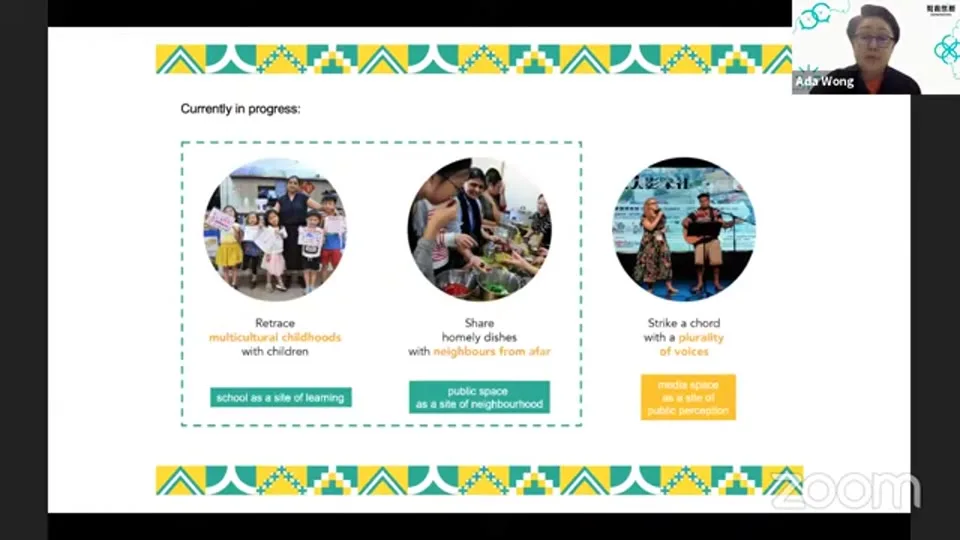
The Jockey Club People’s Art Connective used neighbourhood public spaces and schools to support cultural inclusion. Children learned about halal, vegan and protein foods through art-making, while pottery workshops helped single mothers of different nationalities expand their social networks and work creatively with their children. (0:53:21–1:01:47)
The Good Lab as a bridge
Wong described The Good Lab as a former co-working space that had become a civil-society and social-innovation platform. It acts as an intermediary among government, business and civil society. Empathy, she argued, must be a starting point for leadership and for addressing social problems.
One project connected residents with the Drainage Services Department during plans to upgrade drainage infrastructure in response to climate change. Through listening tours, community engagement and design workshops with children, The Good Lab gathered residents’ views and helped engineers communicate with the community beyond conventional top-down consultation.
The organisation also trained public officials and public-service providers in design thinking and innovation. Wong said the aim was to enlarge and strengthen a tri-sector ecosystem in which civil society, although much smaller than government and business, could help the sectors communicate and face unprecedented challenges.
She concluded that a sustainable, open and democratic ecosystem depends on people who recognise social needs and can narrow differences through communication. Such people should promote understanding and tolerance rather than division. (1:01:48–1:09:08)
Discussion
Adler Yang asked Wong to explain how her initiatives fitted together within a larger ecosystem. Wong depicted Hong Kong as dominated by a government possessing power and a business sector possessing capital, alongside a very small civil society. Her objective was not to make civil society equally large, but to help it grow and intersect with the other two sectors so that social knowledge, experiences, wishes and innovations could affect policy and decision-making.
She distinguished established NGOs, which she characterised as large but conservative providers of schools, churches and welfare centres, from change-making organisations. Her response was to cultivate people willing to propose alternatives and act on them. The School of Creativity demonstrated that a new educational institution could be built; Ednovators developed teachers as change-makers; MaD enabled young people to become change-makers; and The Good Lab prepared young people for tri-sector collaboration. Although each institution was unique, Wong said they catalysed change through experiments ranging “from small to big.” (1:09:09–1:15:57)