Awakening Cooperative Lab · ライブラリー
講演レポート:Adler Yang「学歴主義の底にある『配分依存』を見る――批判的実在論のアプローチ」(2023年)
アドラー・ヨウ(楊逸帆)の「配分依存」論を紹介し、資源獲得の基準が同化、能力の切り捨て、不平等や疎外を生む仕組みを検討する講演報告。
機械翻訳・未校閲
- 日時
- 2023-08-08
- 著者
- ラボによるレポート(草稿は機械生成、未校閲)
- 初出
- Recording on YouTube
- 保存日
- 2026-11-21
- 日時
- 2023-08-08
- 著者
- ラボによるレポート(草稿は機械生成、未校閲)
- 初出
- Recording on YouTube
- 保存日
- 2026-11-21
楊逸帆(アドラー・ヨウ)は、録画では特定されていないイベントのカンファレンス・セッションで、「学歴主義の根底にある〈配分依存〉を見る――批判的実在論からのアプローチ」を発表した。この動画は2023年8月8日にアップロードされた。楊は、教育改革が繰り返されても学歴主義が存続する理由は、〈配分依存〉によって説明できると論じた。すなわち、必要な資源へのアクセスが配分基準を満たすことに依存していると人々が信じるとき、人々はその基準に合わせて自らを作り変え、その結果、社会的な害悪が繰り返し生み出されるのである。
実践的問題から、その根底にあるメカニズムへ
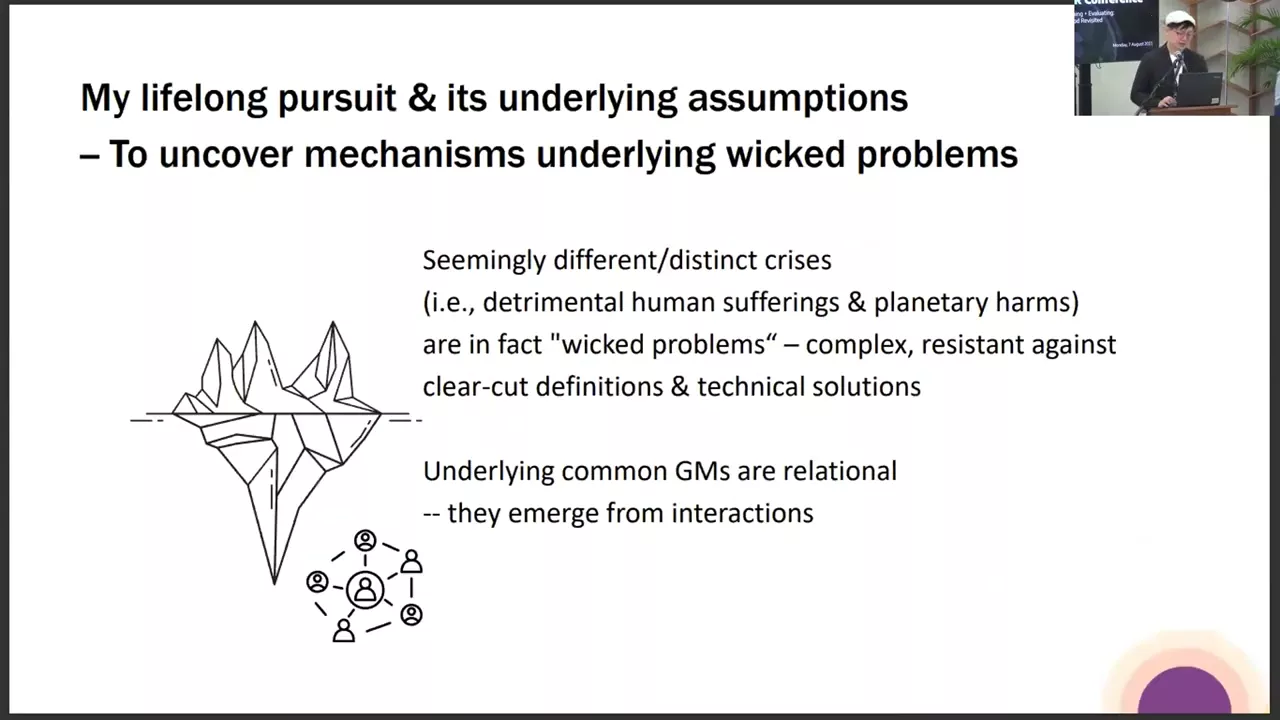
楊は、この研究を、教育改革と社会イノベーションに14年間関わってきた経験のなかに位置づけた。実証主義的、還元主義的、機械論的、人間中心主義的なアプローチは、問題を再生産するメカニズムを温存したまま、改革者を目に見える症状への対処へと向かわせることが多いと彼は述べた。その結果、同じ問題が異なる形をとって再び現れるのである。
彼の独立研究は、当初、複雑系理論に導かれていた。のちに彼は、批判的実在論がこの研究と両立し、それを伝えるうえでも有用であることを見いだした。両者は、因果性について、開放系的、階層的、創発主義的な説明を共有していると彼は述べた。また、厄介な問題の原因が学問分野の境界に沿うとは期待すべきでないことも強調した。
楊が最初の研究領域として教育を選んだのは、10代の彼にも接近可能な領域であったこと、そして、広義の教育が人々の関係のあり方を形づくるからである。彼は、そのために生成メカニズムの形成が比較的観察しやすくなると考えた。振り返ってみると、彼はこの考え方をArcherの形態生成論的アプローチと結びつけていた。彼は、研究の厳密性を高める方法、研究を学術的に適切な複数の論文へ分割する方法、そしてアカデミアを渡り歩く方法について、聴衆に助言を求めた。(0:01:31–0:04:10)
教育改革後の学歴主義
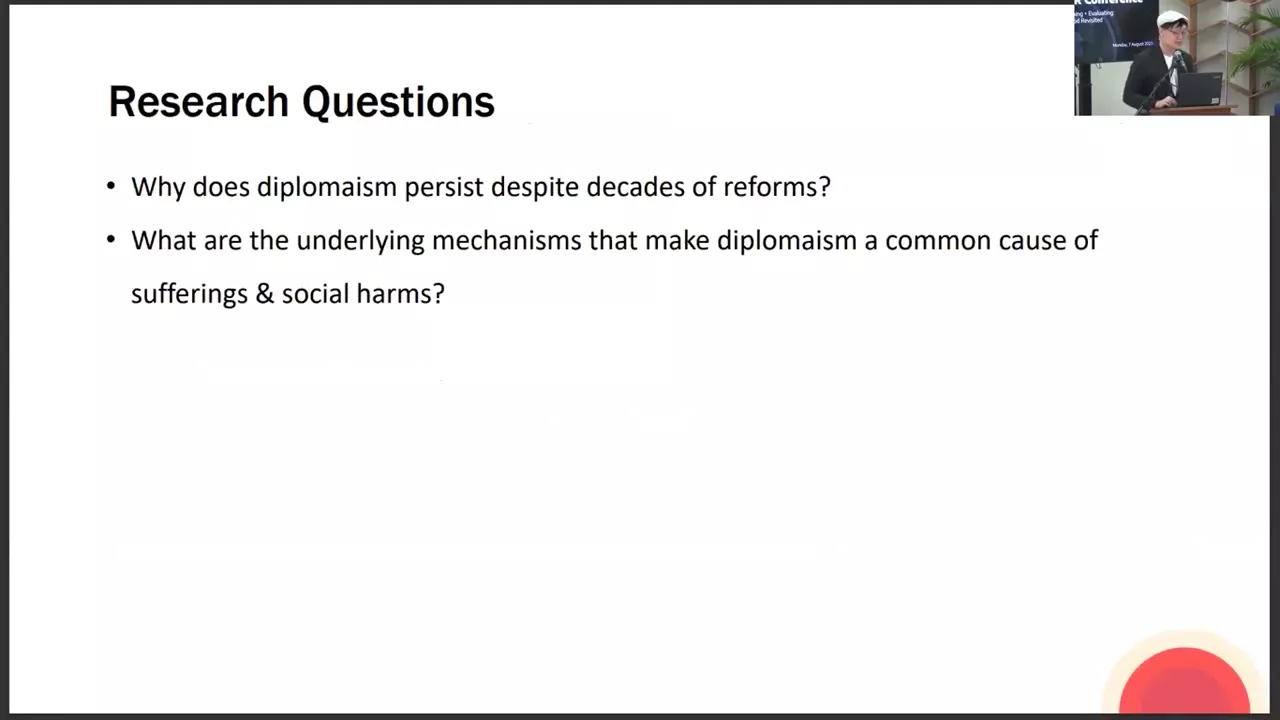
楊が学歴主義を厄介な問題として選んだのは、入試改革後も学歴資格を重視する実践が存続したからである。およそ30年前、生徒たちは入学試験で高得点を取ることに集中していた。その後の改革は、全人的な発達を促し、詰め込み教育や試験対策に偏った指導を減らそうとした。しかし、競争は新たな入学選考基準へと移行した。楊は、生徒が入学選考用のポートフォリオを充実させられるよう、定員の限られた病院ボランティアの枠を得るために、人々が夜通し待っている事例を示した。
彼の研究は、なぜ学歴主義が数十年にわたる改革を経ても存続したのか、そして、どのようなメカニズムが学歴主義を苦しみと社会的害悪の源泉にしているのかを問うた。彼は、一般に受け入れられている説明を2つ特定した。ひとつは、彼が帝国型の儒教と呼ぶものに由来するイデオロギーであり、もうひとつは、望ましい高等教育の希少性と経済的収益によって引き起こされる競争である。
これらの説明を検討するため、楊は、高等教育がもはや希少ではなく、その経済的収益も大きいとはみなされていなかった時期に、教員、保護者、生徒が意識的に該当するイデオロギーと実践を拒絶していた、あるオルタナティブ・スクールを記録した。彼の資料には、のちにドキュメンタリーで使用された映像民族誌と、生徒たちを小学校から大学卒業まで追跡したインタビューが含まれていた。また、彼は生徒たちの家族の社会経済的背景と教育的背景も考慮した。
表面的には、この研究は、伝統的な教育法よりも、学習者中心または自己調整型の教育を支持しているように見えた。しかし、質的観察からは、学校や保護者がその道を強制していないにもかかわらず、生徒たちが自発的に、自らの関心や能力、その他の学びは試験の要件ほど重要ではないと結論づけていることが明らかになった。
楊はこの過程を、一輪車に乗り、ジャズを即興演奏し、Wikipediaが存在する以前に3Dアニメーションを独学し、宇宙の理論モデルを構築していた幼なじみの事例を通して説明した。その生徒は当初、試験で成果を上げることをダイエットコーラになぞらえ、満腹にはなるが栄養はないとして退けていた。しかしのちに、望ましい教育を受ければ自らの潜在能力を実現できると考え、試験に備えるためにこれらの活動を断念した。
その生徒は選抜制の伝統的な高校に進学したが、大学で希望していた専攻には合格できなかった。転学の準備をしていたとき、家計の危機によって収入を得る必要に迫られた。楊は、3Dアニメーションを続けていれば、18歳までに8年間の経験を積めていたかもしれないと推論した。しかし、そうした活動を中断していたため、彼には就労に結びつく技能がなく、家族の負担を軽減するために職業軍人として入隊した。(0:04:11–0:10:29)
〈配分依存〉の構造と作用
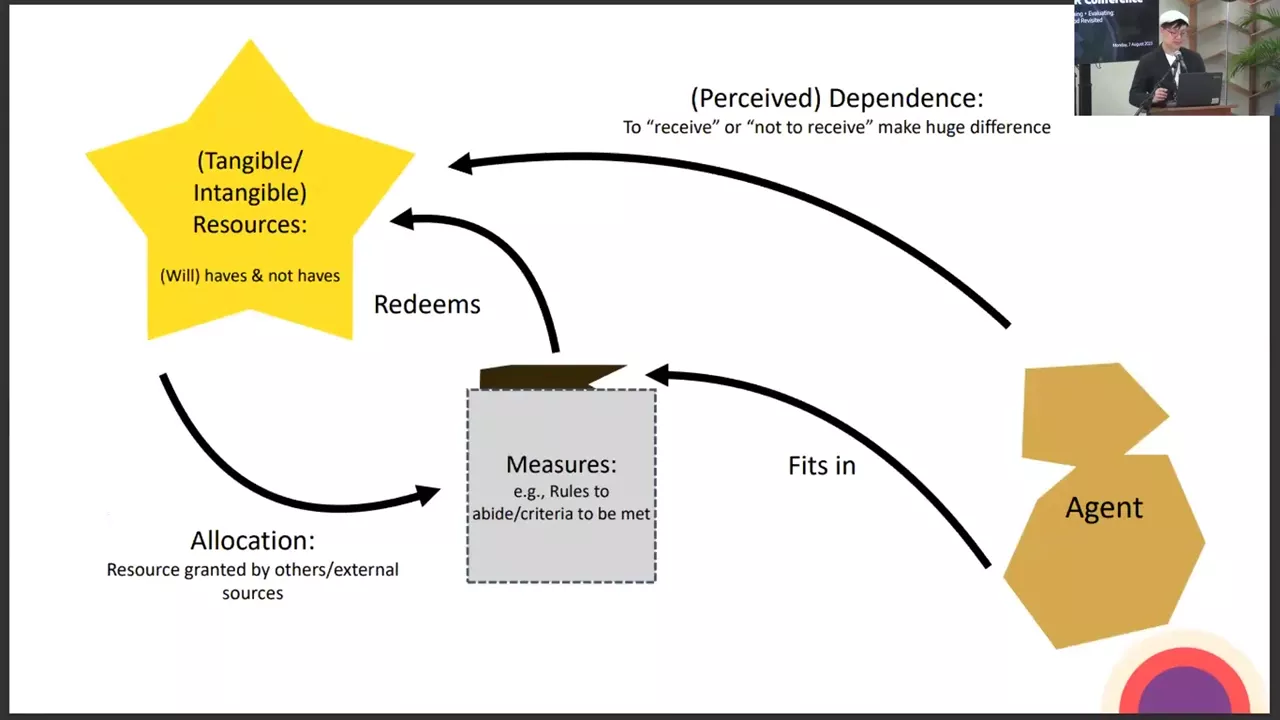
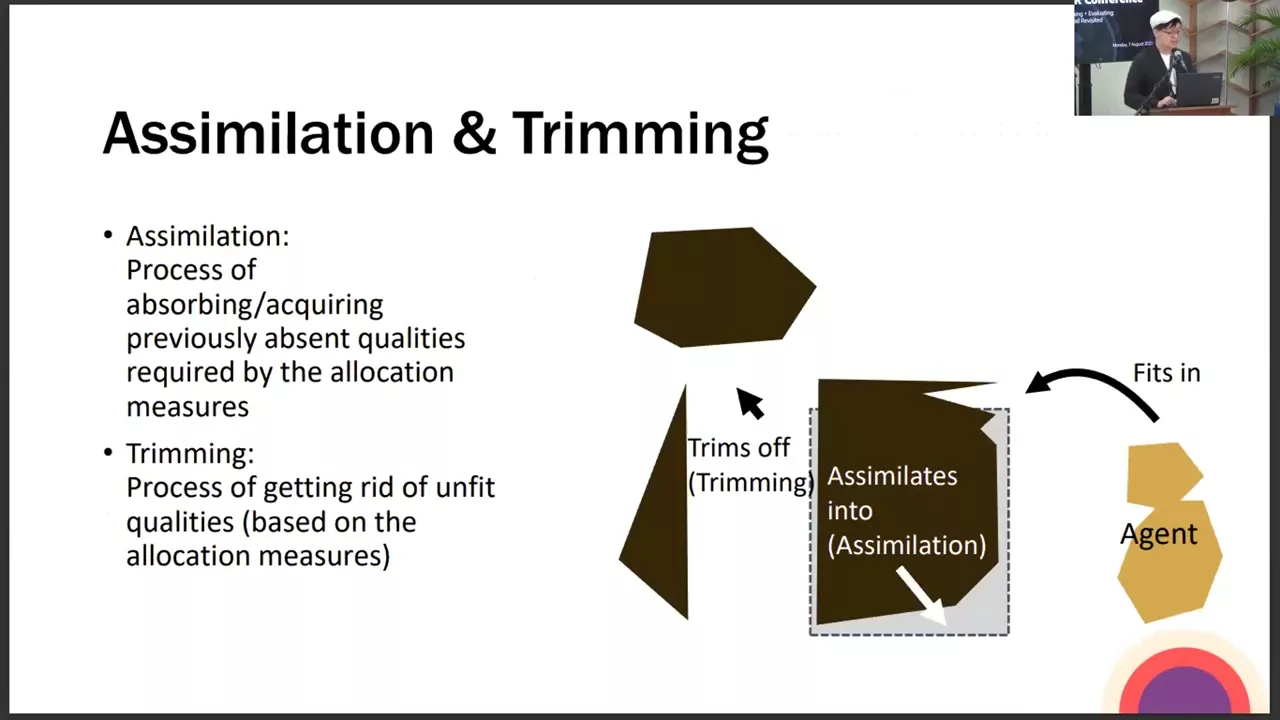
このような事例から、楊は〈配分依存〉という概念を発展させた。このメカニズムは、行為主体が、正確であるか否かにかかわらず、ある資源へのアクセスが配分過程に依存していると認識するときに生じる。そのため行為主体は、その資源を手に入れるために、配分の〈枠〉を満たそうとする。
楊は、直接的に現れる4つの特徴を説明した。「同化」とは、配分の〈枠〉が要求する性質を獲得することであり、「刈り込み」とは、その〈枠〉に適合しない性質を取り除くことである。貨幣化によって、行為主体は、獲得した性質と捨て去った性質のいずれについても、その内在的価値に注意を払わなくなる。配分の〈枠〉への適合は、獲得可能な資源の量や質を決定することによって、貨幣のように機能する。行為主体ごとに配分の〈枠〉との当初の親和性が異なるため、不平等化が生じる。最後に、注意は、資源を循環または再生することから、配分を通じて資源を確保することへと移る。
彼は、〈配分依存〉をいくつかの因果的作用と関連づけた。それは、行為主体の形成と、特定の生の形態を可能にする資源を通じた制御を可能にする一方、フェティシズムが思考と行為に影響を及ぼす。同化、刈り込み、誤配分、内在的価値の軽視は疎外を生じさせることもある。楊はこれを、健康悪化に対応する社会的現象になぞらえた。
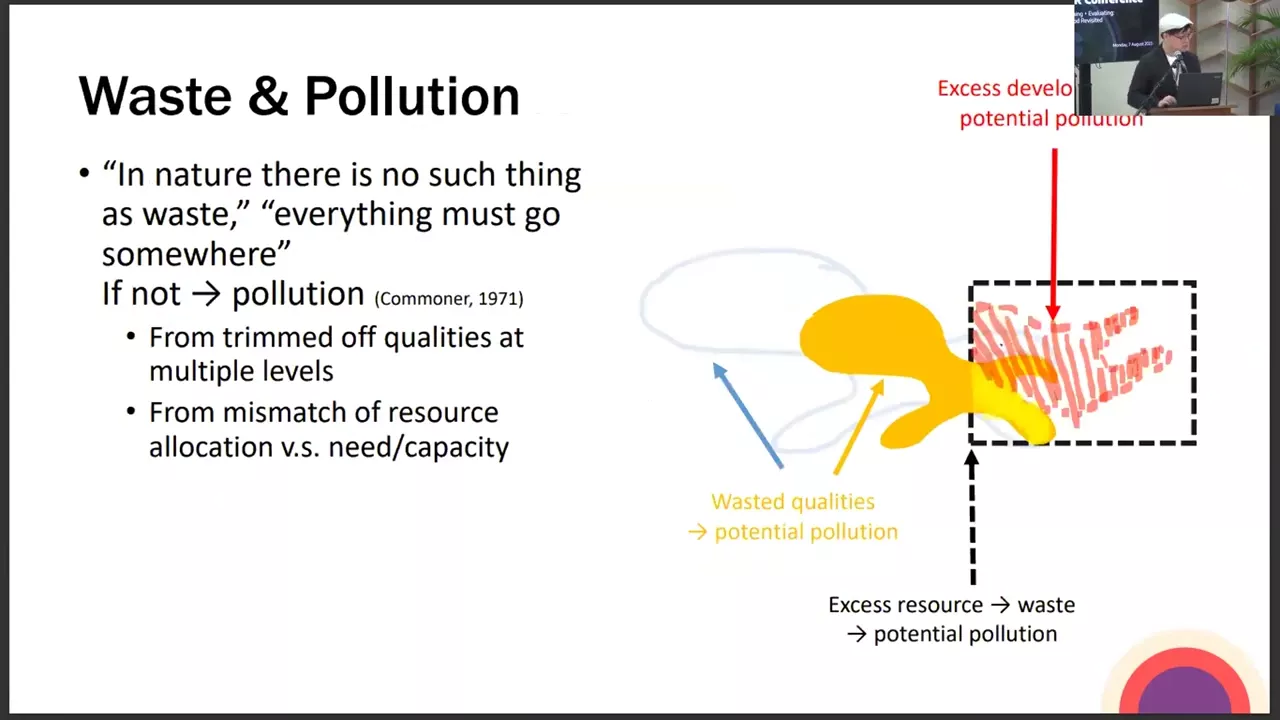
あらゆるものはどこかへ行かなければならないという生態学的命題を用い、楊は、捨て去られた性質を、汚染となりうる廃棄物として捉えた。より広い規模では、学校や労働市場から排除された人々が、自分自身と社会にとってのリスクとなる可能性がある。行為主体が同等の資源をもって出発したとしても、適合性の初期差が時間とともに累積するため、不平等は拡大する。また、再生と再循環が配分と資源獲得の過程の外部へ押し出されると、資源の枯渇も生じる。(0:10:30–0:14:44)
応用、脆弱性、介入の可能性
楊は、〈配分依存〉的な構造は脆弱であると論じた。依存が増大し、冗長性、多様性、代替手段が減少すると、より大規模で洗練されたネットワークほど脆弱になる。彼の事例に登場した生徒の期待を教育システムが満たさなかったときのように、ある部分の機能不全が構造全体を混乱させる可能性がある。
次に彼は、このメカニズムを複数の領域にわたって追跡した。帝政中国では、官職を得るために、受験者は定型化された文学と帝国の古典を暗唱し、その過程で思想の多様性が刈り込まれる性質のひとつとなった。新自由主義体制のもとでは、訓練可能性、即戦力性、STEM能力といった基準が、社会科学と人文学を周縁化しうる。国際関係では、低開発と分類された国々が、資源を獲得するために先進国の課す〈枠〉に適応し、先住民の世界観や生活様式を失う場合がある。人間による食料、住居、保護に依存する動物も同様に、野生で生きる能力を失いながら、家畜性についての人間の基準に従う。種の水準では、それに適合しないものは絶滅する可能性がある。
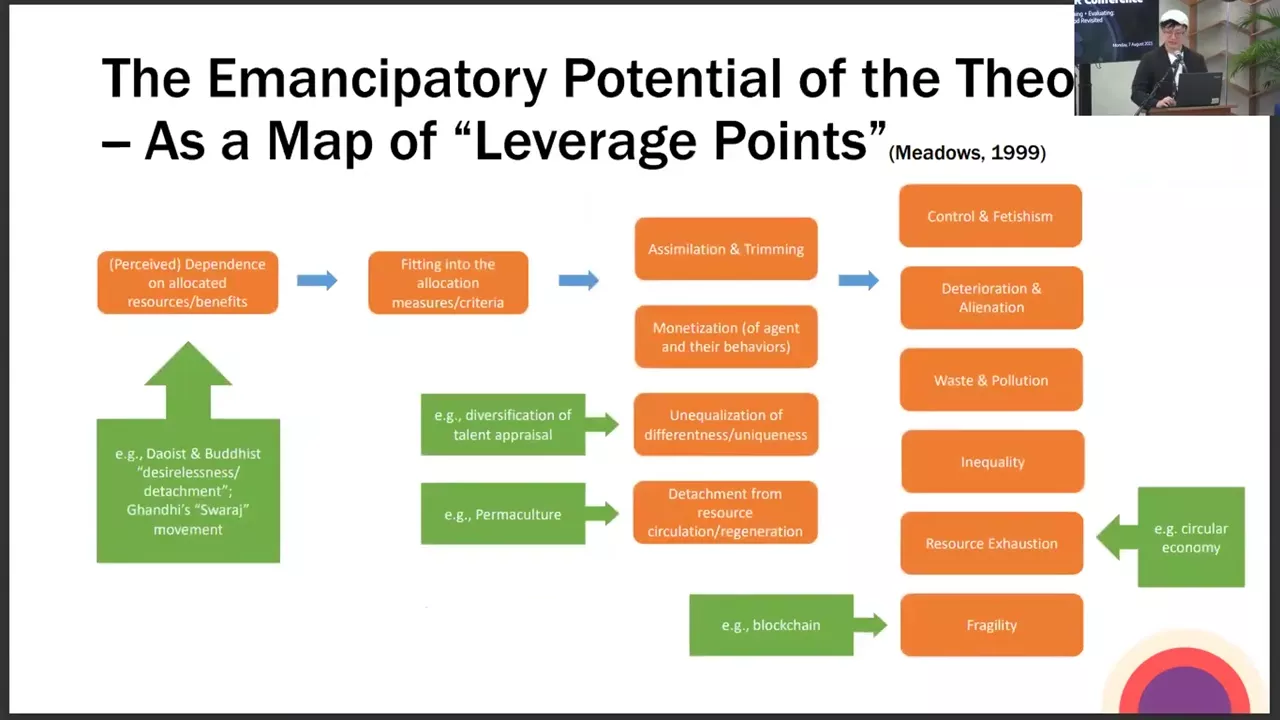
楊は、〈配分依存〉に付随する因果力は、その構造が存在する場所では常に潜在しているが、必ずしも厄介な問題を生じさせるわけではないと主張した。レバレッジ・ポイントのマップによって介入を評価することができる。たとえば、循環経済は資源の枯渇には対処するが、同化と刈り込みというより深層の過程には対処しない。彼は最後に、〈配分依存〉を軽減しうる実践と、それを可能にしたり維持したりする他のメカニズムについて、さらなる問いを提示した。(0:14:45–0:18:58)
討論
匿名の応答者は、能力主義と試験文化に関する文献を検討すること、現実に存在する配分上の制約と認識上の制約とを区別すること、提案されたメカニズムを批判的実在論とより明示的に関連づけること、そして行為主体を中心とするメカニズムと、因果力をもつ外的条件とを分けることを楊に助言した。
Rinaは、「依存」という語が、むしろ工業化された教育システムへ強制的に組み込まれている可能性のある生徒に、過度の責任を負わせるのではないかと問いかけた。フィリピンを引き合いに出し、皿洗いの仕事でさえ学歴資格が要求されうると指摘した。彼女は、帝国的で搾取的な生活様式とともに、構造、行為主体性、文化を検討することを提案した。楊は、自身が台湾で行った自然実験では、一般に提唱される外的な力の一部が存在しなくても、同様の行為が見られたと答えた。複雑適応系の観点から見れば、依存は、外部から強制される場合にも、内部から駆動される場合にも作動しうると彼は述べた。
別の応答者は、複雑系を志向する論考と批判的実在論の論考を含め、資料を複数の論文に分けることを勧めた。Karenは、教育システムが機能不全に陥っているのか、それとも生徒の情熱を抑圧することによって効果的に規律訓練しているのかを問うた。楊は、台湾の教育部がより全人的で創造的な教育を繰り返し目指してきたにもかかわらず、入試改革後も詰め込み教育が存続したと答えた。彼は、隠れたカリキュラムや政府の意図に基づく説明は一部の事例を説明するが、このパターンが繰り返し現れるすべての事例を説明するわけではないと述べた。(0:18:59–0:31:58)
原文を読む
Adler Yang (楊逸帆) presented “Seeing ‘Allocation Dependence’ Underlying Diplomaism — A Critical Realist Approach” in a conference session at an event not identified in the recording; the video was uploaded on 8 August 2023. Yang argued that the persistence of diplomaism despite repeated educational reforms can be explained through “allocation dependence”: when people believe that access to necessary resources depends on satisfying allocation criteria, they reshape themselves around those criteria, producing recurring social harms.
From practical problems to underlying mechanisms
Yang situated the research in fourteen years of involvement in education reform and social innovation. He said that positivistic, reductionistic, mechanistic and anthropocentric approaches often lead reformers to address visible symptoms while leaving the mechanisms that reproduce problems intact. The same problems consequently return in different forms.
His independent research was guided initially by complex systems theory. He later found critical realism compatible with the work and useful for communicating it. Both approaches, he said, share an open-system, stratified and emergentist account of causality. He also stressed that the causes of wicked problems should not be expected to follow disciplinary boundaries.
Yang chose education as his initial field because it was accessible to him as a teenager and because education, understood broadly, forms people’s modes of relationship. He believed that this made the formation of generative mechanisms comparatively observable. Looking back, he associated this reasoning with Archer’s morphogenetic approach. He asked the audience for advice on improving the rigor of the research, dividing it into academically suitable publications and navigating academia. (0:01:31–0:04:10)
Diplomaism after educational reform
Yang selected diplomaism as a wicked problem because practices oriented toward educational credentials persisted even after admissions reforms. Roughly thirty years earlier, students concentrated on achieving high marks in entrance examinations. Later reforms sought to encourage holistic development and reduce cramming and teaching to the test. Yet competition shifted toward new admissions criteria: Yang showed an example of people waiting overnight for limited hospital volunteering places so that students could improve their admissions portfolios.
His research asked why diplomaism had persisted through decades of reform and which mechanisms made it a source of suffering and social harm. He identified two commonly accepted explanations: an ideology driven by what he called an imperial version of Confucianism, and competition caused by the scarcity and economic returns of desirable higher education.
To examine these explanations, Yang documented an alternative school whose teachers, parents and students had consciously rejected the relevant ideology and practices during a period when higher education was no longer scarce and its economic returns were not regarded as strong. His material included video ethnography, later used in a documentary, and interviews tracing students from elementary school through university graduation. He also considered their families’ socioeconomic and educational backgrounds.
At the surface level, the study appeared to support learning-centered or self-regulated education over traditional pedagogy. Qualitative observations, however, showed students voluntarily concluding that their interests, abilities and other learning mattered less than examination requirements, even though the school and their parents did not compel them to take that path.
Yang illustrated the process through a childhood friend who rode a unicycle, improvised jazz, taught himself 3D animation before Wikipedia existed and developed theoretical models of the universe. The student initially dismissed examination achievement, comparing it to diet cola: filling but nutritionally empty. He later abandoned these activities to prepare for tests, believing that a desirable education would help him realize his potential.
The student entered a selective traditional high school but did not gain admission to his preferred university subject. When he prepared to transfer, a family financial crisis required him to earn money. Yang reasoned that continued work in 3D animation might have given him eight years of experience by age eighteen. Having suspended those pursuits, however, he lacked employable skills and joined the military as a professional soldier to reduce his family’s burden. (0:04:11–0:10:29)
The structure and effects of allocation dependence
From such cases, Yang developed the concept of allocation dependence. The mechanism arises when an agent perceives—accurately or otherwise—that access to a resource depends on an allocation process. The agent therefore tries to satisfy its measures in order to redeem the resource.
Yang described four immediate features. “Assimilation” is the acquisition of qualities demanded by the allocation measures, while “trimming” removes qualities that do not fit them. Monetization makes agents less attentive to the intrinsic value of either the acquired or discarded qualities: conformity to the measures functions like money by determining the amount or quality of resources obtainable. Unequalization follows because agents differ in their initial affinity with the measures. Finally, attention shifts away from circulating or regenerating resources and toward securing them through allocation.
He associated allocation dependence with several causal effects. It enables control through the formation of agents and the resources that permit particular forms of life, while fetishism influences thought and conduct. Assimilation, trimming, misallocation and neglect of intrinsic value can also produce alienation, which Yang compared to the social counterpart of deteriorating health.
Using the ecological proposition that everything must go somewhere, Yang treated discarded qualities as waste that can become pollution. At a broader scale, people excluded from schools or labor markets may become risks to themselves and society. Inequality grows because initial differences in fit compound over time, even if agents begin with equal resources. Resource exhaustion also follows when regeneration and recirculation are externalized from the allocation-and-redemption process. (0:10:30–0:14:44)
Applications, fragility and possible intervention
Yang argued that allocation-dependent structures are fragile: larger and more sophisticated networks become vulnerable when dependence increases and redundancy, diversity and alternatives decline. Failure in one part may disrupt the whole structure, as occurred when the educational system did not fulfill the expectations of the student in his example.
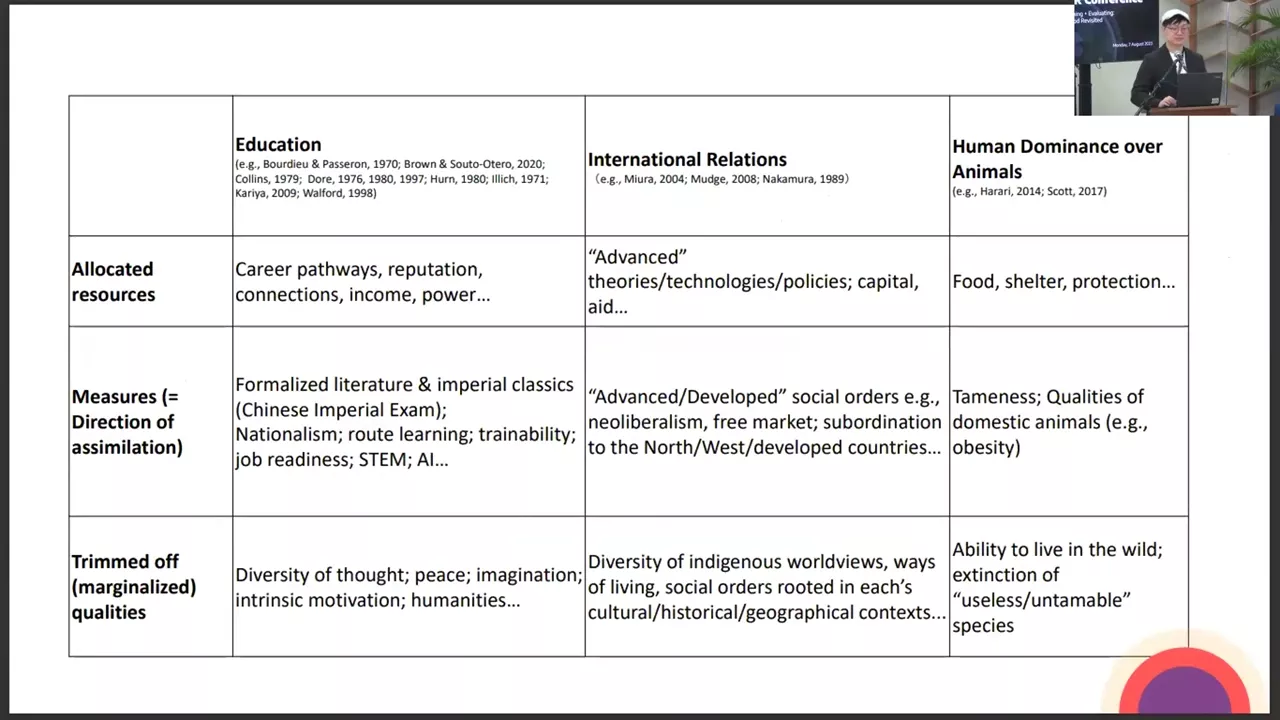
He then traced the mechanism across domains. In imperial China, candidates recited formalized literature and imperial classics to obtain bureaucratic posts, with diversity of thought among the qualities trimmed away. Under a neoliberal regime, criteria such as trainability, job readiness and STEM capacity can marginalize the social sciences and humanities. In international relations, countries categorized as underdeveloped may adapt to measures imposed by developed countries to obtain resources, losing Indigenous worldviews and ways of living. Animals dependent on human food, shelter and protection similarly conform to human criteria for domesticity while losing capacities for life in the wild; at the species level, those that do not fit may become extinct.
Yang maintained that the causal powers associated with allocation dependence remain available wherever the structure exists, although they do not always generate wicked problems. A leverage-points map could evaluate interventions: the circular economy, for example, addresses resource exhaustion but not the deeper processes of assimilation and trimming. He closed by identifying further questions about practices that might reduce allocation dependence and other mechanisms that enable or sustain it. (0:14:45–0:18:58)
Discussion
An unnamed respondent advised Yang to review literature on meritocracy and examination culture, distinguish realistic allocation constraints from perceptions, connect the proposed mechanism more explicitly to critical realism and separate agent-centered mechanisms from external conditions with causal powers.
Rina questioned whether “dependence” placed too much responsibility on students who might instead be forced into industrialized educational systems. Citing the Philippines, she noted that credentials could be required even for dishwashing work. She suggested examining structure, agency and culture, as well as an imperial and exploitative mode of living. Yang replied that his Taiwanese natural experiment showed similar conduct even without some commonly proposed external forces. From a complex adaptive systems perspective, he said, dependence could operate whether externally enforced or internally driven.
Another respondent recommended separating the material into different articles, including complexity-oriented and critical-realist treatments. Karen questioned whether the educational system was dysfunctional or effectively disciplining students by suppressing their passions. Yang answered that Taiwan’s Ministry of Education had repeatedly sought more holistic and creative education, yet cramming persisted after admissions reforms. He proposed that accounts based on hidden curricula or governmental agendas explained some cases but not every recurrence of the pattern. (0:18:59–0:31:58)