Awakening Cooperative Lab · ライブラリー
講演レポート:Dennis Li「学び方を教えることで、より優れた学習者を育てる」
Dennis Liが、振り返りと教師の助言で学習法を育て、人間関係を代替しない教育技術を説いた講演記録。
機械翻訳・未校閲
- イベント
- 教育における反脆弱性のパラダイムへ:焦点をEE(有効性と効率性)からRR(レジリエンスと頑健性)へ移す (TIES 2020)
- 日時
- 2020-11-22
- 著者
- ラボによるレポート(草稿は機械生成、未校閲)
- 初出
- Recording on YouTube
- 保存日
- 2026-11-22
- イベント
- 教育における反脆弱性のパラダイムへ:焦点をEE(有効性と効率性)からRR(レジリエンスと頑健性)へ移す (TIES 2020)
- 日時
- 2020-11-22
- 著者
- ラボによるレポート(草稿は機械生成、未校閲)
- 初出
- Recording on YouTube
- 保存日
- 2026-11-22
Sown To Growの共同創設者兼CTOであるDennis Liは、2020年11月22日にオンラインで開催された2020年台湾国際教育サミット(TIES、台灣國際教育高峰會)のセッション1「ホリスティック教育テクノロジーの可能性」で講演した。サミットのキュレーターであり同セッションの司会者でもある楊逸帆(アドラー・ヨウ)の紹介を受け、Liは、生徒が自らの学び方についても省察することで、目標設定と進捗把握はより有用になると論じた。また、教育テクノロジーは、教師と生徒との関係に取って代わろうとするのではなく、教師がこの実践を育むのを支援すべきだと主張した。
Sown To Growとその省察実践
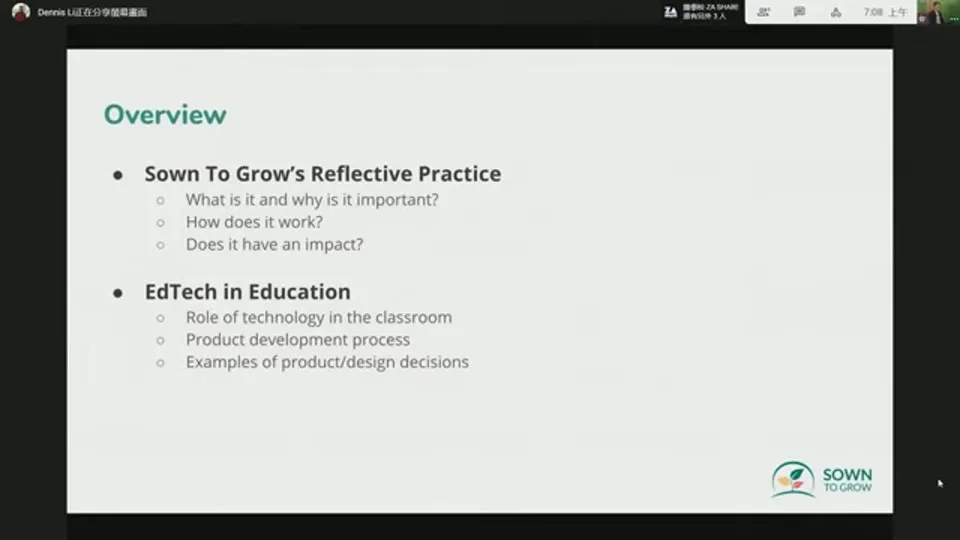
Liは、Sown To Growを、自身と共同創設者のRupa Guptaが約5年前に設立した米国拠点の教育テクノロジー企業として紹介した。米国の数百校の生徒が同社のプラットフォームを利用し、学習目標を設定し、進捗を把握し、成果に寄与した方略を省察していた。教師はこのプロセスを指導するためにプラットフォームを利用していた。さらに同社は、全米科学財団からの資金提供を受け、教師がより良いフィードバックを提供できるよう支援することを目的とした機械学習および言語処理技術も導入していた。
最高技術責任者として、Liはチームとともにこのプラットフォームを構築してきた。自身の経歴については、工学、公共政策、教育政策、民間部門におけるソフトウェア開発と分析、さらにカリフォルニア州サンノゼの大規模な学区における管理職としての勤務にまたがるものだと述べた。
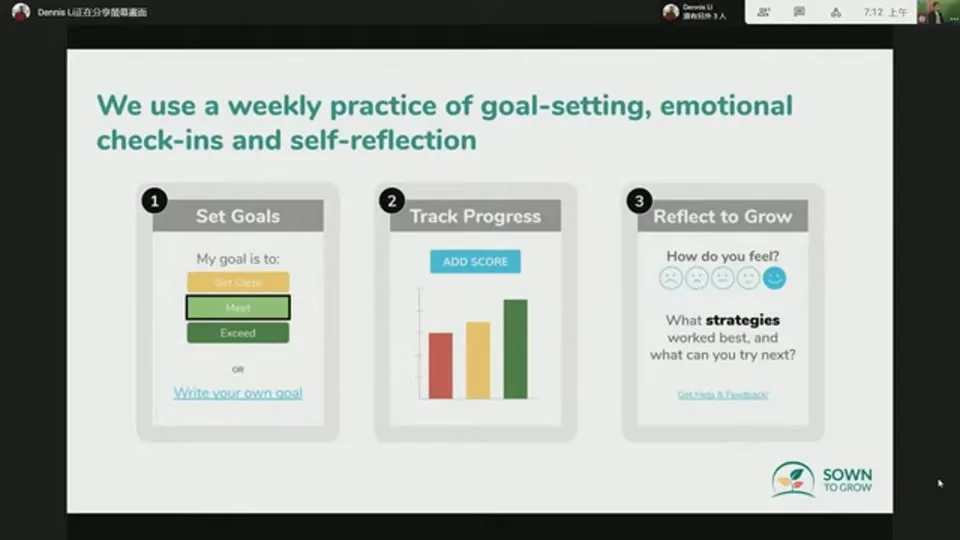
この製品の基盤となる実践は、反復的な一連の手順に沿うものであった。生徒は目標を設定し、進捗を記録し、短い感情状態の確認を行い、自らの成果を分析する省察を書いた。ほとんどの導入事例では、生徒はこのサイクルを毎週実施していた。Liは、学校にはすでに目標設定やデータの記録に関する経験があるかもしれないが、省察の段階は特に強い関心を集める傾向にあると述べた。それによって生徒には、目標を達成したかどうかだけでなく、なぜそのような結果になったのかを考える機会が定期的に与えられるのである。(0:05:17–0:09:27)
固定的な結論から代替的な方略へ
Liは、目標設定と進捗把握だけでは、時として有益でない結論をかえって強化しかねないと論じた。その例として、毎週語彙テストを受ける中学生を挙げた。その生徒はA評価を取るという目標を設定し、すべての結果を注意深く記録するかもしれない。しかし、毎週C評価が続けば、蓄積されたデータによって、自分には成功するための生得的な能力が欠けていると考えるようになる可能性がある。Liはこのような結論を、研究上「固定的マインドセット」と呼ばれるものに結びつけた。
省察は、それとは異なり、生徒がLiのいう「成長マインドセット」、すなわち能力は伸ばすことができるという信念を育む可能性を高めるためのものであった。期待外れの結果を恒久的な限界の証拠として扱うのではなく、生徒は変化をもたらす方法を見いだすことができる。語彙テストであれば、前夜に練習問題に取り組む、辞書では理解しにくかった定義を友人に説明してもらう、十分な睡眠を取ることで自らのウェルビーイングに配慮するといった方法が考えられる。うまくいった方法は継続し、うまくいかなかった方法は次のサイクルで別のものに置き換えることができる。
Liは、自身の経験を通じてこのプロセスを説明した。高校では好成績を収め、優れた大学に進学したものの、それまでプログラミングの経験がないままコンピュータ科学を学び始めた際には苦労した。より良い成果を上げていた友人たちが、異なる取り組み方を教えてくれた。Liはプログラミングの課題に早めに着手し、時間管理を改善し、オフィスアワーに出向いて助けを求め、授業で学んだ理論を実践的な環境で応用できるインターンシップに取り組むようになった。大学最後の2年間の成績は、最初の2年間よりも大幅に向上した。Liによれば、Sown To Growは、生徒のために一貫した省察実践を確立することで、このような支援に出会えるかどうかに伴う運の要素を取り除こうとしていたのである。(0:09:27–0:13:38)
省察の育成と成果の測定
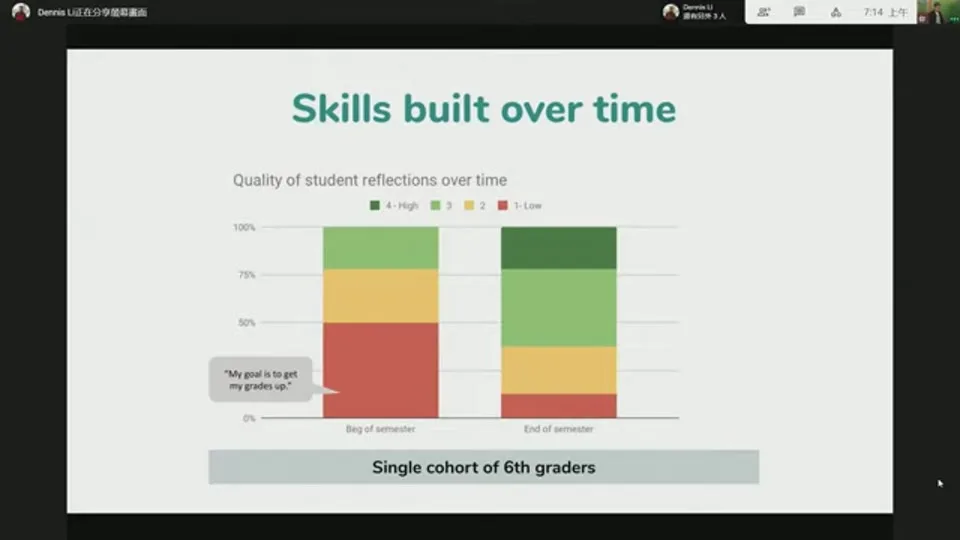
Liによれば、省察のための時間を設けるだけでは不十分であった。省察それ自体が、育成を要する技能だからである。Sown To Growは全米科学財団からの資金提供を受け、省察の質を評価するための4段階のルーブリックを作成した。実践を始めた当初、多くの生徒は、目標を述べるだけで、その達成方法を説明しない質の低い回答を書いていた。生徒は、定期的な実践と、とりわけ教師からのフィードバックを通じて、メタ認知能力を向上させることができた。
Liは、この省察実践を一学期間にわたって行った6年生を対象とする研究に言及した。学期末までに、生徒の省察の質は著しく向上していた。後期の回答では、休み時間に語彙をより多く勉強するといった具体的な行動が、学習目標およびその目標が達成されたかどうかを判断する方法と結びつけられていた。
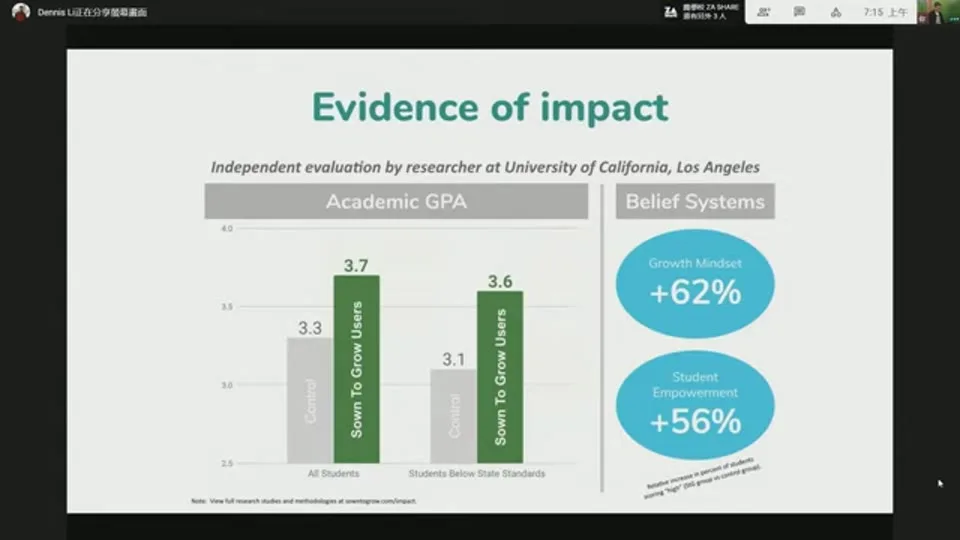
同社はさらに、ある学校の類似した2つの生徒集団、すなわちSown To Growを利用する集団と利用しない集団を比較することで、この実践の効果を測定した。学期末には、プラットフォーム上でこの実践を日常的に行っていた生徒のほうが成績が高かった。年度当初に数学および国語で州の基準を下回っていた生徒の間では、両集団の差がより顕著であった。成長マインドセットおよび自らの学習を主体的に進められるという生徒の感覚に関する事前・事後調査でも、同様に、この実践を利用した集団の得点がより高かった。(0:13:38–0:15:40)
教育テクノロジーの原則
続いてLiは、省察実践そのものから、製品設計を導く原則へと話題を移した。第一の原則は、教室の文脈を理解する必要性であった。学校と教育者は、相互に競合する数多くの優先事項に直面していた。メタ認知能力を育成することは重要であるが、数学、科学、国語、社会科を学ぶこともまた重要である。教育者が省察を重視していたとしても、毎週1時間をそれに割くことはできないかもしれない。したがって設計上の課題は、教師が担う他の責務と並行して実施できるよう、この実践を利用しやすいものにすることであった。
第二の原則は、教育者の役割に関するものであった。教育分野での過去の職務経験に基づき、LiとGuptaは、教師、カウンセラー、管理職が果たす機能はテクノロジーで容易に代替できるものではないと考えていた。彼らのアプローチは、テクノロジーを用いて、教育者と生徒との関わりや関係性を向上させるというものであった。
第三の原則は効率性であった。Liは、テクノロジーを適切に利用すれば、教育に関わる業務をより効率的にできると述べた。省察実践において、これは、生徒を指導しフィードバックを提供する教師の役割を維持しながら、教師に求められる労力を軽減する方法を見いだすことを意味した。(0:15:40–0:17:43)
原則を製品上の判断に落とし込む
Sown To Growは当初、プラットフォームに高い柔軟性を持たせ、生徒が何を記録し、何について省察するかを教師が決められるようにしていた。その後、同社は教師が製品を利用するさまざまな状況を観察し、幅広く適用できると思われる定型的な実践を特定した。そして、これらの実践をすぐに利用できるモジュールとしてまとめた。
そのようなモジュールの一つが「毎週の学習チェックイン」であった。生徒は週に1度、すべての授業の成績を記録し、その成績を向上させるために翌週何をするかを省察した。Sown To Growは必要な足場かけを追加し、教師がわずかな手順だけでこの実践を開始できるようにした。
フィードバックは、もう一つの設計上の問題をもたらした。教師は生徒に新しい方略を提案する必要があったが、なかには毎週100件を超える生徒の省察に対応しなければならない教師もいた。同社は全米科学財団からの助成金を用いて、生徒の省察を読み取り、その内容に基づくフィードバックを提案する機械学習技術を開発した。同じ技術によって類似した省察をグループ化し、教師が関連するフィードバックを複数の生徒に提供できるようにした。Liによれば、これらのツールは、教師と生徒との関係を代替するのではなく、それを深めながら、教師がより多くの生徒に働きかけられるよう支援することを目的としていた。(0:17:43–0:20:54)
原文を読む
Dennis Li, Co-founder and CTO of Sown To Grow, spoke at Session 1, “The Possibility of Holistic Education Technology,” of the online 2020 Taiwan International Education Summit on 22 November 2020. Introduced by summit curator and session host Adler Yang, Li argued that goal-setting and progress tracking become more useful when students also reflect on how they learn, and that education technology should help teachers develop this practice without attempting to replace their relationships with students.
Sown To Grow and its reflective practice
Li introduced Sown To Grow as a US-based education technology company founded about five years earlier by Li and his co-founder, Rupa Gupta. Students in hundreds of US schools used its platform to set learning goals, monitor their progress, and reflect on the strategies contributing to their results. Teachers used the platform to guide this process. With funding from the National Science Foundation, the company had also incorporated machine-learning and language-processing technology intended to help teachers provide better feedback.
As chief technology officer, Li had built the platform with his team. He described his background as spanning engineering, public policy, education policy, private-sector software development and analytics, and work as an administrator in a large school district in San Jose, California.
The practice underlying the product followed a recurring sequence. Students set goals, tracked their progress, completed a brief emotional check-in, and wrote a reflection analysing their performance. In most implementations, students completed this cycle weekly. Li noted that schools might already have experience with goal-setting and data tracking, but said the reflection stage tended to attract particular interest. It created a regular opportunity for students to consider not only whether they had achieved a goal, but why a particular result had occurred. (0:05:17–0:09:27)
From fixed conclusions to alternative strategies
Li argued that goal-setting and progress tracking alone could sometimes reinforce an unhelpful conclusion. He gave the example of a middle-school student taking a weekly vocabulary quiz. The student might set a goal of receiving an A and carefully record every result. If the student continued to receive a C each week, however, the accumulated data could lead to the belief that the student lacked the innate ability to succeed. Li associated this conclusion with what research calls a fixed mindset.
Reflection was intended to improve the likelihood that students would instead develop what he called a growth mindset: the belief that abilities can be developed. Rather than treating a disappointing result as evidence of a permanent limitation, students could identify approaches to change. For a vocabulary quiz, they might take practice quizzes the night before, ask a friend to explain definitions that were difficult to understand in a dictionary, or attend to their well-being by getting sufficient sleep. Successful approaches could be retained, while unsuccessful ones could be replaced in the next cycle.
Li illustrated this process with his own experience. Although he had earned good grades in high school and entered a strong university, he struggled when he began studying computer science without previous programming experience. Friends who were performing more successfully showed him different ways to work. He began programming assignments earlier, improved his time management, attended office hours to seek help, and pursued internships where he could apply classroom theory in practical settings. His performance in the final two years of college was considerably better than in the first two. Sown To Grow, he said, sought to remove the element of luck involved in encountering such support by establishing a consistent reflective practice for students. (0:09:27–0:13:38)
Developing reflection and measuring results
Simply allocating time for reflection was not sufficient, Li said, because reflection itself was a skill that needed to be developed. With National Science Foundation funding, Sown To Grow created a four-point rubric for assessing reflection quality. When students first began the practice, many produced low-quality responses that stated a goal without explaining how they would reach it. Through regular practice and, importantly, feedback from teachers, students could improve their metacognitive skills.
Li referred to a study of sixth-grade students who used the reflective practice for an entire semester. By the end of the semester, the quality of their reflections had improved significantly. Their later responses connected specific actions, such as studying more vocabulary during a break, with a learning goal and a way of determining whether the goal had been achieved.
The company also measured the practice by comparing two similar groups of students at one school, one using Sown To Grow and one not using it. At the end of the semester, students who routinely completed the practice on the platform had higher grades. Among students who began the year below state benchmarks in mathematics and language arts, the difference between the groups was more pronounced. Pre- and post-surveys concerning growth mindset and students’ sense of empowerment in their learning likewise produced higher scores for the group using the practice. (0:13:38–0:15:40)
Principles for education technology
Li then turned from the reflective practice itself to the principles guiding the product’s design. The first was the need to understand the classroom context. Schools and educators faced numerous competing priorities. Building metacognitive skills mattered, but so did learning mathematics, science, language arts and social studies. Even if educators valued reflection, they might not be able to allocate an hour every week to it. The design challenge was therefore to make the practice accessible alongside teachers’ other responsibilities.
The second principle concerned the role of educators. Drawing on their previous work in education, Li and Gupta believed that teachers, counsellors and administrators performed functions that technology could not easily replace. Their approach was to use technology to improve educators’ interactions and relationships with students.
The third principle was efficiency. Li said that appropriate uses of technology could make educational work more efficient. In the reflective practice, this meant finding ways to reduce the effort required from teachers while preserving their role in guiding students and providing feedback. (0:15:40–0:17:43)
Translating the principles into product decisions
Sown To Grow initially made its platform highly flexible, allowing teachers to decide what students would track and reflect upon. The company then observed the different settings in which teachers used the product and identified routines that appeared broadly applicable. It packaged these routines as ready-to-use modules.
One such module was the “weekly academic check-in.” Students recorded their grades across all classes once a week and reflected on what they would do during the following week to improve them. Sown To Grow added the necessary scaffolding so that teachers could begin the routine with only a few steps.
Feedback presented another design problem. Teachers needed to suggest new strategies to students, but some had more than 100 student reflections to address each week. Using its National Science Foundation grant, the company developed machine-learning technology that read students’ reflections and suggested feedback based on their content. The same technology grouped similar reflections, allowing a teacher to respond to multiple students with related feedback. Li said these tools were intended to help teachers reach more students while deepening, rather than replacing, their relationships with them. (0:17:43–0:20:54)
つながり
中央がこのページです。サイトの記録に基づいて、このページとつながりのあるページや人を、それぞれ印で示しています。二つの印を結ぶ線は、それぞれの印が示すページや人の間にもつながりがあることを表します。