Awakening Cooperative Lab · ライブラリー
講演レポート:黃慧勤「故郷への還流圏――教育のコミュニティ・デザイン」(KASpaces 台湾ナショナル・セミナー、2021年)
Hui-Chin Huangの講演報告で、大溪での地域学習が若者の主体性と帰郷の道を育てた10年を追う。
機械翻訳・未校閲
- イベント
- 「台湾の教育のDNAを読み解く:進歩と平等はどこに見られるか」(KASpaces 台湾ナショナル・セミナー)
- 日時
- 2021-10-23
- 著者
- ラボによるレポート(草稿は機械生成、未校閲)
- 初出
- The speaker’s recorded talk for the seminar
- 保存日
- 2026-11-22
- イベント
- 「台湾の教育のDNAを読み解く:進歩と平等はどこに見られるか」(KASpaces 台湾ナショナル・セミナー)
- 日時
- 2021-10-23
- 著者
- ラボによるレポート(草稿は機械生成、未校閲)
- 初出
- The speaker’s recorded talk for the seminar
- 保存日
- 2026-11-22
健行科技大学室内デザイン・マネジメント学科の講師Hui-Chin Huangは、2021年10月23–24日に開催されたオンラインKASpaces全国セミナー「教育における進歩と公平性の加速」のセッション2「台湾教育のDNAを読み解く――進歩と平等はどこに見いだせるか?」において、この事前収録講演を行った。Huangは、大溪における10年間の教育実験を紹介し、コミュニティを基盤とする学習は、若者を故郷と再び結びつけ、彼らの主体性を育み、地元に戻って働いたり地域の取り組みを立ち上げたりするための支援ネットワークを形成しうると論じた。
若者とコミュニティとの断絶を認識する
Huangは2011年に故郷の大溪へ戻るようになり、当初は若者に故郷への帰還を促す教育キャンペーンに参加していた。台湾の観光地上位10選を選出する地元のキャンペーンをきっかけに、彼女は大溪がどのように表象されているのか、また当時大学生であった自分がその住民や地域の暮らしについていかに知らなかったかを見直すようになった。彼女は、若者に地域についての知識や地域との関係が欠けていることが、彼らが故郷を離れる一因であると考えるに至った。
Huangは、台湾における若者の正規教育は、とりわけ進学を重視する制度のもとで、コミュニティの暮らしから切り離されていると論じた。そこで彼女のチームは、高校生が大溪を離れる前に彼らと活動することを目指した。大溪老街から徒歩約15分の場所には、壁一枚を隔てて2校の中等学校が建っていた。一方は学問と試験を重視する学校であり、もう一方は私立の職業学校であった。
チームはまず職業高校の生徒を対象に、彼らがすでにコミュニティとどのようなつながりをもっているかを調べた。生徒たちはマクドナルド、インターネットカフェ、飲食店、公共空間の一角などに集まっていた。放課後に地元の事業所でアルバイトをする者もいた。Huangは、これらの活動がコミュニティ生活の欠如ではなく、独自の文化的・社会的文脈を構成していることを強調した。生徒たちは、先住民族文化やその他の地域文化の実践ともつながりをもっていた。このことからチームは、若者自身の文脈を起点として教育を設計し、彼らの場所感覚を広げることができるのではないかと考えるようになった。(0:00:02–0:04:28)
スタディツアーから大溪カリキュラムへ
チームは、地元の参加者を招き、既存の観光の枠組みから外れた大溪の諸側面を探究する若者向けスタディツアー・プログラムを開始した。活動には、川沿いの先住民族コミュニティを訪れること、若者が老街周辺で何をしているかを調べること、大溪の山間部に入ること、歴史ある農村集落を訪問することなどが含まれていた。このプログラムは、若者同士および若者とコミュニティを結びつけるとともに、帰郷して地域の事業を始める可能性を開くことを意図していた。
これらのスタディツアーはその後、「Daxi Wow Wow Wow」と呼ばれる3日間の非公式な夏季講座へと発展した。Huangは3つの目的を挙げた。地域への帰属意識と自己認識を引き出すこと、若者をコミュニティと結びつけて場所感覚を広げること、そして彼らの空間に関する発想を地域史の提示と組み合わせることである。6つの講座モジュールは、感覚を通じた関わりと大溪への印象から出発し、歴史と日常生活を経て、調査と公開発表へと進む構成であった。
生徒たちの地図からは、彼らが実際に生きる地理が、公的な表象とはいかに異なるかが明らかになった。あるバスケットボールコートは、生徒たちの放課後生活の中心であったため、地図上で大きく扱われていた。幅6メートルの路地は、駐車場が不足して歩行者と車両が同じ混雑した空間を通らざるをえなかったため、幹線道路のように認識されていた。プログラムでは、触覚を用いた活動、音の収集、音楽、ストリートダンス、映画、インタビュー、演劇も取り入れた。6か月後、あるグループは得られた知識を大溪についての演劇にまとめ、公開上演した。
カリキュラムは参加者に応じて変化した。初期の徒歩ツアーで大半の生徒が取り残された際、チームは注意を持続させるため、ゲームや歴史上の役割を演じるロールプレイを導入した。後年には、参加者が自分のペースでコミュニティ文化を探索できる、携帯電話を利用した現実空間ゲームも追加した。Huangは、こうして生まれた構成を、知識を受け取る段階から、コミュニティに入り調査する段階へ、さらに若者の視点を可視化するかたちで彼らの創造性を活用する段階へと進む過程として要約した。(0:04:29–0:10:50)
世代間のフィールド学習
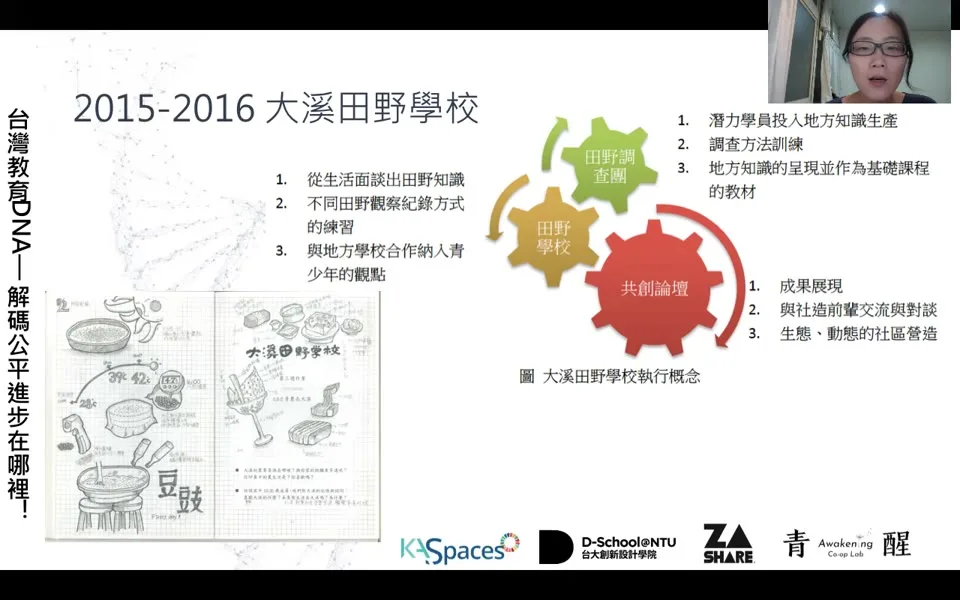
プログラムがコミュニティの関心を集めるにつれ、2015年にはフィールドスクールのプロジェクトが始まった。最初のテーマは、食文化と家族の食卓をめぐる物語であった。コミュニティの参加者は夏季にフィールドワークを行い、9月に学校が再開すると、生徒と住民がともに学べるよう、このプロジェクトは職業高校の授業に組み込まれた。
大半が母親であったコミュニティのメンバーは、供物台にまつわる儀礼と文化的意味を生徒たちに紹介した。その後、参加者は共同で供物台の模型を制作した。別の授業では、それぞれの家族が好む料理のレシピを共有した。Huangはこの教室を、高齢者、中年層、若者が対等な立場で交流する場として捉えた。授業の成果として、レシピとポストカードが制作された。
共創の段階では、高校の教員がコミュニティのメンバーに映画制作を教えた。参加者が絵コンテを作成して脚本について議論する一方、生徒たちは学校で身につけた専門的技能を生かして映画を編集した。2か月後にはコミュニティでプレミア上映が行われた。Huangはこれを、17歳から70歳までの人々が関わる学習の仕組みとして説明した。彼女によれば、この過程は新たな社会関係を生み出し、若者と他の住民との間にあった疎遠さを和らげた。(0:10:50–0:13:53)
若者の主体性と帰郷への道筋を育む
Huangによれば、この10年間の実験は、若者の社会関係資本と文化資本を増大させることを目指していた。その継続には、活動に参加し、高校の授業設計を支援し、カリキュラムを開発し、住民の実践知を地域の教育知へと変えていくコミュニティの協力者を見つけることが不可欠であった。
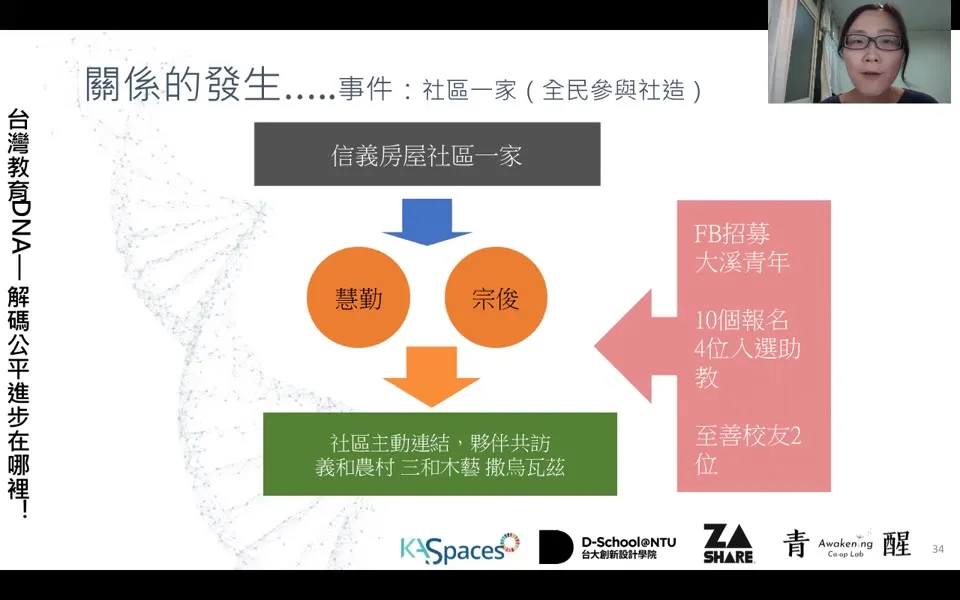
オンライン上のコミュニティ・ネットワークも人材募集を支えた。資金を得た後、Facebookで募集を行ったところ10人の応募があり、そのうち4人がティーチング・アシスタントとなった。職業高校の元生徒2人も招かれた。Huangは、アシスタントたちが異なる分野での経験を持ち寄り、後には自らコミュニティに関する企画を立案するようになったと述べた。ある参加者は中国の伝統絵画と地域知を組み合わせようとし、別の参加者はコミュニティのソーシャル・マーケティングについて学校で学んだことを地域での実践に結びつけた。
プログラムは、異なる世代を順次結びつけるものでもあった。地元の母親たちが当初運営していたコミュニティのサマーキャンプでは、子どもたちを世話し、日常生活の技能を教えていた。8年後、その子どもたちの一部は大学生として戻り、中心的な役割を担った。Huangは、子どもの頃に参加し、その後Daxi Wow Wow Wowに加わり、最終的に芸術・人文学の教員として大溪小学校に戻ったMomoについて語った。Momoは、陣頭(Din Tao)や先住民族文化を含む地域の実践を初等教育に取り入れた。
ほかの元参加者たちも、働いたりプロジェクトを立ち上げたりするために戻ってきた。Huangは、プログラムの第2期に参加し、後に大学生年代のティーチング・アシスタントを務め、先住民族の知識を生かしたコミュニティ教育活動を企画したZhiweiに言及した。他地域に暮らす元アシスタントたちも、専門的経験を提供できる態勢を保ち、学校教員、卒業生、現役大学生が、より広範な若者コミュニティを形成した。(0:13:55–0:19:31)
地域創生のための教育コミュニティ
Huangは最後に、相互につながる3つの段階について説明した。すなわち、コミュニティの課題と地域知を調査すること、交流を通じて関係を育むこと、そして若者の主体性を示すコミュニティ・アクションを提案することである。旅をし、学び、住民とつながり、共同で企画を立案することによって、参加者は故郷での取り組みをともにつくる主体として位置づけられた。
10年間にわたり、これらの活動はHuangが「目に見えない教育コミュニティ」と呼ぶものを形成した。それは、若者、学校、住民の間の関係を仲介し、学校とコミュニティの共学を支え、帰郷を考える人々に社会的資源を提供した。したがって、教育設計は、若者が地域知と創造的資源を蓄積できる関係を生み出したのである。
Huangにとって、この過程は場所感覚を育むことから始まり、若者が故郷で可能な生き方をつくり出すことへと広がっていった。このように、コミュニティを基盤とする教育設計は、共同学習と地域での行動を通じて蓄積された関係を土台として、地域創生のための継続的な支援ネットワークを構築しうるのである。(0:19:34–0:21:38)
原文を読む
Hui-Chin Huang, Lecturer in the Department of Interior Design and Management at Chien-Hsin University of Science and Technology, delivered this pre-recorded talk in Session 2 of the online KASpaces National Seminar on Accelerating Progress and Equity in Education, “Decoding the DNA of Taiwan Education: Where Do We See Progress and Equality?”, held on 23–24 October 2021. Presenting a decade of educational experimentation in Daxi, Huang argued that community-based learning can reconnect young people with their hometown, develop their agency, and create a support network for returning to work or establish local initiatives.
Recognising the disconnection between youth and community
Huang began returning to her hometown of Daxi in 2011, initially participating in an educational campaign encouraging young people to return to their hometowns. A local campaign to select Taiwan’s top ten tourist towns prompted her to reconsider how Daxi was represented and how little she, then a university student, knew about its residents and local life. She came to see young people’s lack of local knowledge and relationships as one reason they left their hometowns.
Huang argued that young people’s formal education in Taiwan was disconnected from community life, particularly within a system oriented toward academic progression. Her team therefore sought to work with high-school students before they left Daxi. Two secondary schools stood about a 15-minute walk from Daxi Old Street and were separated from each other by only a wall: one was academically and examination oriented, while the other was a private vocational school.
Beginning with vocational high-school students, the team examined their existing connections to the community. The students gathered at McDonald’s, an internet café, food and drink shops, and corners of public space. Some worked part-time in local businesses after school. Huang emphasised that these activities constituted a distinctive cultural and social context rather than an absence of community life. The students also had connections to Indigenous culture and other local cultural practices. This led the team to ask whether educational design could begin from young people’s own contexts and expand their sense of place. (0:00:02–0:04:28)
From study tours to the Daxi curriculum
The team initiated a youth study-tour programme that invited local participants to explore aspects of Daxi outside its established tourist framework. Activities included visiting riverside Indigenous communities, investigating what young people did around the old streets, entering Daxi’s mountain areas, and visiting historic rural settlements. The programme was intended to connect young people with one another and with the community while opening possibilities for returning home to start local enterprises.
These study tours were subsequently developed into a three-day informal summer course called Daxi Wow Wow Wow. Huang described three aims: eliciting local and personal identity, connecting young people to the community and broadening their sense of place, and combining their spatial ideas with presentations of local history. Six course modules moved from sensory engagement and impressions of Daxi through history and everyday life to investigation and public presentation.
Students’ maps revealed how their lived geography differed from formal representations. A basketball court appeared prominently because it was central to their after-school lives. A six-metre alley was perceived as a main road because insufficient parking forced pedestrians and vehicles into the same crowded space. The programme also used tactile activities, sound collection, music, street dance, film, interviews, and theatre. After six months, one group assembled its knowledge into a play about Daxi and performed it publicly.
The curriculum changed in response to participants. When an early walking tour left most students behind, the team introduced games and historical role-play to sustain attention. In later years it added mobile-phone-based reality games that allowed participants to explore community culture at their own pace. Huang summarised the resulting structure as a progression from receiving knowledge, to entering and investigating the community, to using youth creativity in ways that made young people’s perspectives visible. (0:04:29–0:10:50)
Intergenerational field learning
As the programme attracted community attention, a field-school project began in 2015. Its first theme concerned food culture and family dining-table stories. Community participants conducted fieldwork during the summer; after school resumed in September, the project was incorporated into a vocational high-school course so that students and residents could learn together.
Community members, most of them mothers, introduced students to the rituals and cultural meanings of offering tables. Participants then constructed an offering-table model together. In another class, people shared recipes for their families’ favourite dishes. Huang characterised the classroom as a setting in which older, middle-aged, and younger participants interacted on equal terms. The course produced recipes and postcards.
During a co-creation stage, a high-school instructor taught community members filmmaking. Participants designed storyboards and discussed the script, while students applied their school-based professional training to edit the film. A community premiere followed two months later. Huang described this as a learning mechanism involving people from 17 to 70 years old. In her account, the process created new social relationships and reduced unfamiliarity between young people and other residents. (0:10:50–0:13:53)
Developing youth agency and pathways home
Huang said the ten-year experiment sought to increase young people’s social and cultural capital. Its continuation depended on finding community partners who would join activities, help design high-school classes, develop curricula, and turn residents’ practical knowledge into local educational knowledge.
Online community networks also supported recruitment. After funding became available, a Facebook call attracted ten applicants, four of whom became teaching assistants; two former students from the vocational high school were also invited. Huang observed that the assistants brought experience from different fields and later began formulating community proposals themselves. One participant sought to combine traditional Chinese painting with local knowledge, while another connected school learning about community social marketing with local practice.
The programme also linked successive generations. A community summer camp initially organised by local mothers had cared for children and taught everyday skills. Eight years later, some of those children returned as university students and took leading roles. Huang discussed Momo, who had participated as a child, later joined Daxi Wow Wow Wow, and eventually returned to Daxi Elementary School as an arts and humanities teacher. She incorporated local practices, including Din Tao and Indigenous culture, into primary education.
Other former participants returned to work or establish projects. Huang mentioned Zhiwei, a participant in the programme’s second cohort who later served as a university-age teaching assistant and planned community educational activities drawing on Indigenous knowledge. Former assistants living elsewhere remained available to contribute professional experience, while schoolteachers, graduates, and current university students formed a broader youth community. (0:13:55–0:19:31)
An educational community for regional revitalisation
Huang concluded by describing three connected stages: investigating community issues and local knowledge, developing relationships through interaction, and proposing community action that demonstrated young people’s agency. Travelling, learning, connecting with residents, and jointly developing proposals positioned participants as co-creators of hometown initiatives.
Across ten years, these activities formed what Huang called an invisible educational community. It mediated relationships among young people, schools, and residents; supported co-learning between schools and communities; and provided social resources for those considering a return home. Educational design therefore generated relationships through which young people could accumulate local knowledge and creative resources.
For Huang, the process began with developing a sense of place and extended to young people creating possible lives in their hometown. Community-based educational design could thereby establish a continuing support network for regional revitalisation, grounded in relationships accumulated through shared learning and local action. (0:19:34–0:21:38)
つながり
中央がこのページです。サイトの記録に基づいて、このページとつながりのあるページや人を、それぞれ印で示しています。二つの印を結ぶ線は、それぞれの印が示すページや人の間にもつながりがあることを表します。