Awakening Cooperative Lab · ライブラリー
流行のシステム変革の影で――名門大学はいかに不利な立場の学生を支えられなかったか、あるいは批判的実在論とエージェント・ベースのアプローチのために
学校の外で伸び、選抜性の高い大学で消耗した仮名の学生 Wen の物語を通じて、流行のシステム変革の手法が閉じた機械的システムを再生産しうると論じ、批判的実在論とエージェント・ベースのアプローチを提案する論考。
機械翻訳・未校閲
- 日時
- 2024-07-17
- 著者
- アドラー・ヨウ(楊逸帆)
- 初出
- Illuminate Network (Medium)
- 保存日
- 2026-11-22
- 日時
- 2024-07-17
- 著者
- アドラー・ヨウ(楊逸帆)
- 初出
- Illuminate Network (Medium)
- 保存日
- 2026-11-22
目次
- 学校から得た「偶然の自由」……
- ……そして復学後の「予想外の転落」
- 「貧しい子どもを(良い)大学へ入れる」――エビデンスに基づくレバレッジ・ポイントなのか?
- ウェンを抑圧したメカニズム:〈配分依存〉
- ウェンをエンパワーしたメカニズム:Learning by Caring(ラーニング・バイ・ケアリング)
- ウェンの物語を再考する:Learning by Caring(ラーニング・バイ・ケアリング)と〈配分依存〉の影響
- 精緻化するシステム「モデル」、消滅するシステム「思考」:機械論的閉鎖システムの実証主義的再生産
- 批判的実在論に基づくエージェント・ベースのアプローチ:自らが「変化となる」ために、私たちが従って生きるルールを変える
- 参考文献
学校から得た「偶然の自由」……
大学に行かずとも、ウェン* (これは仮名であり、本人のプライバシーを保護するため、一部の個人情報を変更している) は専門職として活躍していた。ところが、大学への進学は、彼女を再び貧困の罠の瀬戸際へと引き戻した。
ひとり親の低所得世帯で育ったウェンは、常に勤勉で、他者への思いやりに満ちていた。懸命に勉強して市内でも比較的優れた高校の一つに進学し、激しい競争と重圧のなかでも好成績を維持した。しかし、祖父が事故に遭い、彼女が高校を退学してその介護者となったことで、すべてが変わった。
家庭の経済的困難を理由に学校を辞めることは、10代での妊娠、薬物、犯罪への道筋のように聞こえるかもしれない。しかし、ウェンの場合、実際にはその逆であった。彼女は、自らが全面的に主導権を握ることで、学びがより効果的で、自分に関係の深いものになると気づいた。祖父の介護に加えて、子どもへの思いやりによって、彼女は難関大学に通うほかの大学生たちよりも際立ち、有給の家庭教師の仕事に採用された。
彼女は、自らの「自己主導型教育」、仕事、自己実現、自律性、そして新たな生活様式の柔軟性を楽しんだ。身体的な負担はあったものの、祖父の介護は単に彼女を消耗させるだけではなく、充足感をもたらすものでもあった。祖父との絆は深く、彼女は祖父との会話を楽しんでいた。
しかし、時が経つにつれて、自らの将来をめぐる問いが影を落とすようになった。母親は、たとえ家計にかなりの経済的負担がかかるとしても、彼女に学校へ戻って大学に進学してほしいと望んだ。
ウェンはジレンマに直面した。自律的に学ぶほうが学校に戻るよりはるかに費用対効果が高いと感じており、大学で何を学ぶのかもまだ定まっていなかった。何も得られないかもしれないのに、母親にそれほど大きな経済的負担を負わせたくはなかった。しかし同時に、母親を心配させたくもなかった。また、大学に行かないという決断が、自分の人生に重大な悪影響を及ぼすのではないかとも懸念していた。
ウェンはこのジレンマを青醒人共生文化智庫(Awakening Cooperative Lab)に持ち込み、私たちによる「Reflexive Media(協働学習型メディア)」のパイロット・プロジェクトを通じて検討した(Yang and Pi, 2012; Yang, 2020)。このプロジェクトは、オーディエンスである学習者が、自分たちが取り上げたい問題をクラウドソーシングし、その後、共同探究にともに取り組むというモデルに基づいている。このアプローチでは、メディア・コンテンツは、一方向的な情報の「供給」――教育における標準的な詰め込み型モデル――ではなく、間主観的かつ再帰的な学習の産物となる(図1)。
当時、このプロジェクトが焦点を当てていたのは、高等教育と雇用の関係であった。ウェンは、労働市場の専門家へのインタビューに参加し、大学教育を受けた求職者の供給過剰について学んだ。また、大学学位を持たない専門職へのインタビューを通じて、職場における彼ら自身の(自己)教育の経験から学んだ。さらに、「過剰教育」と「不完全雇用」の現象を研究するなかで、大学へ進学する前に、まず職場において教育への情熱をさらに探究したいと考えるようになった。彼女は、共同探究の成果をまとめた『Awakening Magazine』(「覚醒マガジン」)を一冊、母親に持ち帰った。ウェンが参加した綿密な研究に安心した母親は、彼女が直接働き始めることを認めた(図2.1および2.2)。
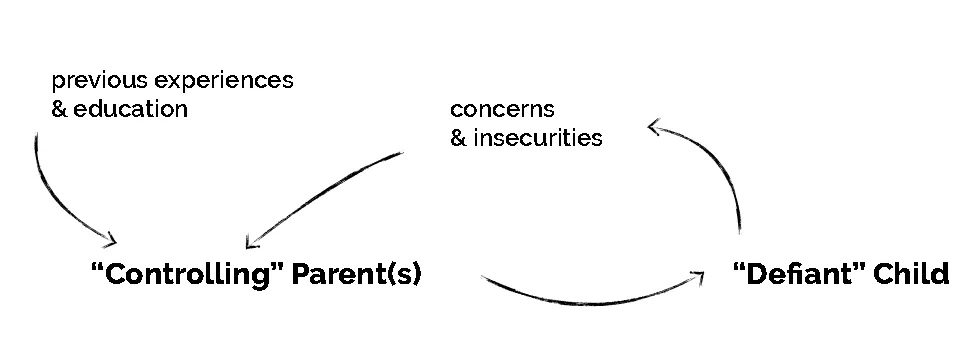
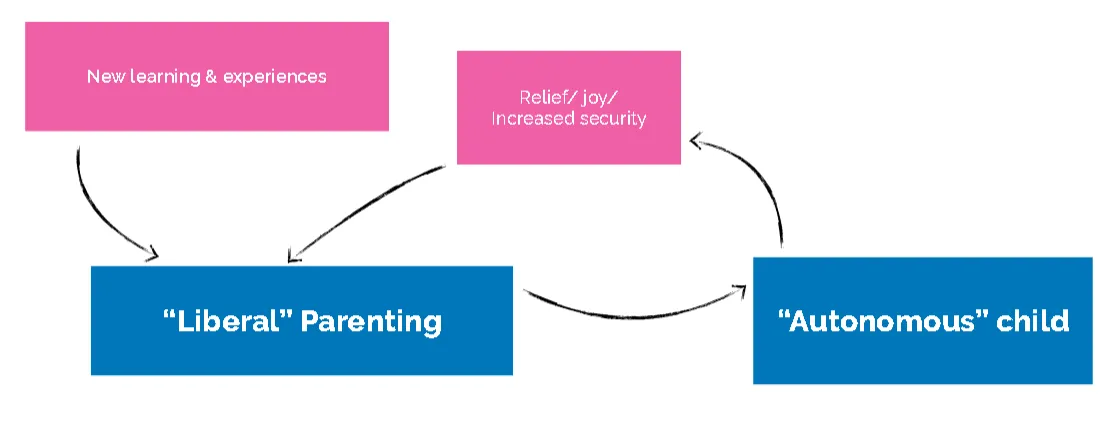
放課後プログラムの教師として出発したウェンは、その情熱と勤勉さ、そして学業成績だけではなく、一人の全人的な存在として子どもに注意を向ける姿勢によって、ほどなくして同プログラムの指導的立場へ昇進した。その後まもなく、職場での評判を受けて、オルタナティブ・スクールの創設メンバーとして加わるよう招かれた。同時に、彼女の物語は多くの人々を勇気づけるものとなった。彼女は講演への招待を受けるようになり、最終的には、教育への貢献によって総統教育賞を授与された。
……そして復学後の「予想外の転落」
実践を通じて何年も探究した末に、彼女は教育の道を追求したいという確信を得た。そして長期的に見れば、信頼される教育者になるためには――とりわけ、教育者になることをめぐる社会規範を考慮すれば――より高い学位を取得するほうがよいだろうと考えた。
彼女はポートフォリオによって、入学試験を一切受けずに、台湾で最も入学難易度の高い大学の一つに合格した。彼女の社会経済的背景や、出身高校と進学先大学の選抜性の隔たりを考えれば、地域の高校に復学し、従来の試験経路で出願することは、ほとんど不可能だったはずである。
不利な境遇にありながら高い成果を上げてきた若者が「名門」大学に入ることは、上方移動の成功を保証するように聞こえるかもしれない。しかし、世界中の多くの学生の人生と同様に、ウェンの人生も一般的な通念に反するものとなった。ごく少数の例外を除き、彼女の大学生活は、卒業要件を満たすためだけの、自分には関係の薄い授業――たとえば、彼女が何年も先駆的実践に携わってきたことに照らせば時代遅れの授業――で埋め尽くされた。成績に基づく奨学金を受け続けるためには、成績やクラス順位が落ちないよう、放課後の時間の相当部分を学業に充てなければならなかった。彼女の大学が国内でも特に競争の激しい大学の一つであったため、なおさらである。しかし大学に通うかたわら、自分自身と家族を経済的に支えるため、仕事も続ける必要があった。大学の学業負担が重かったため、別の都市にあるオルタナティブ・スクールでのフルタイムの仕事を続けることはできなかった。代わりに、代替されやすく反復的なパートタイムの補助業務にしか就けず、報酬が低いだけでなく、彼女の能力や人柄が真に価値をもたらせる職でもなかった。低賃金であれば、経済的必要を満たすために、より長く働かなければならない。しかし、大学の要件によって、働ける時間には厳しい上限が課された。皮肉なことに、教育への情熱をよりよく追求するために大学へ入ったにもかかわらず、現実はそれとは程遠いものとなった。大学から課された生活様式によって、彼女は心身ともに疲弊し、自らの情熱である学習者中心の全人教育について、専門的能力をさらに発展させる余地をまったく得られなかった。
ウェンは、自分自身と家族の経済的必要を満たすだけの時間を働くため、各学期の履修単位数を減らさなければならなかった。大学生活が提供するとされるもう一つの重要な資産である課外活動や自発的な学生活動も、時間と体力が限られていたため、彼女にはまったく縁がなかった。それでも、労働時間を延ばして得られる収入は、フルタイムの仕事による水準をはるかに下回っていた。学業とパートタイム労働の双方で過重労働を続けたことで健康が損なわれ、単位不足による卒業の遅れは、この有害な状況を長期化させ、さらに悪化させた。最終的に、何年にも及ぶ燃え尽きの末、彼女の健康は破綻した。もはや大学へ通うことはできなかった。同時に、その健康状態では、より少ない労働時間でより多く稼ぐ必要があったため、オルタナティブ教育の仕事に戻ることも現実的ではなかった。
ほとんど選択肢がないまま、彼女は教育の世界を完全に去った。
彼女は職業を変えた――収入とセルフケアのための時間を得るべく、アロマセラピスト兼美容師となったのである。
「貧しい子どもを(良い)大学へ入れる」――エビデンスに基づくレバレッジ・ポイントなのか?
上方移動と社会の改善には(高等)教育が不可欠であると強調する、貧困削減の主流の「科学/エビデンスに基づく」「体系的アプローチ」(たとえばBanerjee and Duflo, 2012を参照)に照らせば、ウェンの物語は例外的な事例のように聞こえるかもしれない。しかし、この論理とウェンの物語を詳しく検討すれば、学習、教育、社会移動、不平等の現実は、見かけ上客観的な数字が示すよりも、常に複雑で微妙なものであることがわかる。
簡潔にするため、「貧困に対する主要な解決策としての高等教育」あるいは「貧しい子どもを(良い)大学へ入れる」という見方の根底にある前提を、以下の正のフィードバック・ループとして要約できる(図3)。
図3.「上方移動のための介入としての教育(学校教育)」の背後にある前提(インタラクティブ・マップ)
- より多くの、またはより良い学校教育
- は、より多くの、またはより優れた技能と知識を形成し、意思決定を改善する(_人的資本_という見方に関連する。参照:Becker, 1994; Mincer, 1974; Schultz, 1961)。
- より多くの、またはより良質な文化資本、社会関係資本、象徴資本を蓄積する(_社会的・文化的再生産_という見方に関連する。参照:Bourdieu, 1979; 1989; 2018)。
- そして、被雇用者としての望ましさがより高いことを示す(_シグナリングという見方_に関連する。参照:Arrow, 1973; Spence, 1973; Stiglitz, 1975)。
- これらはすべて、より高度なキャリア上の選択肢や人生の機会へのアクセスに寄与し、それらは、より大きな所得と結びつくと想定されている。
- 所得が増えれば、自分自身または子どものために、より多くの、またはより良い学校教育を負担できるようになり、フィードバック・ループが強化される。
- 不利な境遇にある若者に「良い教育」(たとえば、「良い」大学への入学および通学のための経済的支援)を与えることは、その若者を制約的な社会経済的背景から切り離し、本人の努力によってこのような正の循環に入るための平等な出発点を提供しようとするものである(たとえばBanerjee and Duflo, 2012を参照)。
しかし、紙やデジタル形式の学位記それ自体は、さほど有用ではない。就学達成***** (これはしばしば「教育達成」と呼ばれる。しかし、「学校で過ごす年数が多いこと」または「より高い段階の学校での学業を修了すること」は、必ずしも「より多くの教育」と同じではないというIllich(1971)の議論に従い、ここでは代わりに「就学達成」という語を用いる) は、この因果関係を理解するために有用な概念であるものの、能力、さまざまな形態の資本、被雇用者としての望ましさのいずれも、学位記という一片の文書を取得した効果へと還元できないことは明白である。想定されているこれらの便益は、学校教育の年月をどのように過ごすか、社会の経済構造のもとでの人材の需給、所得や税などに関する規制をはじめとする多くの主要因の結果である。これらはこの全体像のなかで重要な役割を果たすものの、開放システムの特徴である因果の網の目に依然として従属している。たとえば、人材供給の過剰に影響され、台湾の大学卒業者は、自らの就学達成水準に見合う就業機会が最も少なく、就学達成の低い人々に比べて失業率が最も高い(行政院主計総処, 2024; Yang 2021a)。
ウェンを抑圧したメカニズム:〈配分依存〉
ウェンの物語をさらに理解するうえでは、二つの概念、すなわち二つのシステム的メカニズムの理解が不可欠である。
第一は、〈配分依存〉である(Yang 2021a; 2023a; 2023b)。これは、行為主体が配分される資源に依存し、それゆえ、本来的な価値や、それを行う意味ではなく、主として配分の尺度(たとえば、基準、手段、過程)に適合するよう、その資質を同化し、刈り込む過程を経たのち、「貨幣化された資質」によってそのような資源を換金することに専念する際に作動するメカニズムを記述するものである。言い換えれば、〈配分依存〉にある人は、配分の尺度によりよく、またはより多く適合すればするほど、資源配分の過程またはシステムから、より良質な、またはより多くの資源を得られるという前提のもと、取引的な仕方で自分自身を変えることに専念する。
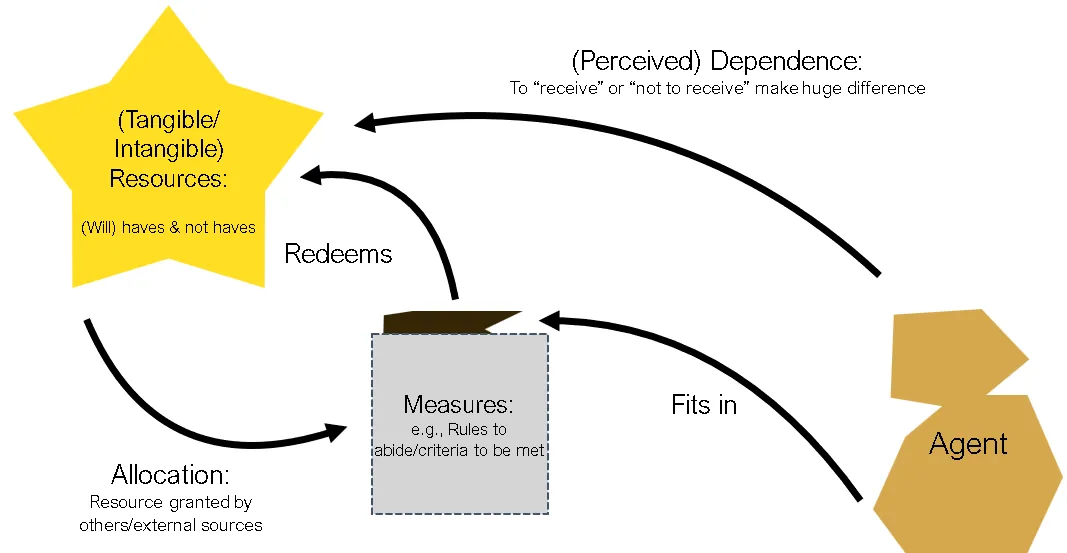
教育の文脈では、このメカニズムは、学生が教育機関――たとえば、学校、大学、そしてそれらを結びつける進路振り分け/説明責任などのシステム――による資源配分に依存するときに、しばしば観察される。ただし、親や教師によって強制されることも決して珍しくない。配分される資源には、たとえば、自らの能力やさまざまな形態の資本を増大させる機会がある。次の段階の学校教育へ進む前に、学生は、「良い」学校/大学へ入るうえで優位に立てるものを身につけなければならず、その妨げとなりうる活動、情熱、特性の一部を手放さなければならないこともある。同様に、成績、証明書、奨学金、特定のプログラムへの参加資格、あるいは学位記などの資源を受け取るためには、学生は前提要件を満たさなければならない。時間とエネルギーが有限である以上、これはしばしば、別の方向に自分自身を発達させることを犠牲にして行われる。
このメカニズムには、多くの創発的問題が含まれている。ここでは、そのうちいくつかだけを挙げる。
- 個人はそれぞれ異なる特性(たとえば、背景、特徴、性向)を持つため、共通の尺度のもとに置かれれば、常に、ほかの人々よりもその尺度に適合しやすい人々が生じる。言い換えれば、このメカニズムには、すでに不平等が組み込まれている(図4.2)。
- 同時に、資源を「換金」するために配分の尺度を「満たす」ことへと関心と努力が向けられるにつれ、〈配分依存〉にある行為主体は、資源を「再生」することをやめ、存在し機能していると想定された資源のプールと、単に「 交換 」するだけになる。その交換は、しばしば何らかの形の_競争_として行われる(図4.3)。
- しかし、努力は配分の尺度への良好な適合を保証しない。配分の尺度への良好な適合も、資源の換金の成功を必ずしも保証しない(たとえば、ほかにも「同じ程度に適合する者」がいるためである)。資源の換金に成功しても、行為主体の文脈に照らした当該資源の有用性や価値は保証されない(たとえば、社会/経済構造も変化するため、より高い学位が必ずしもより良いキャリア機会をもたらすわけではない)。言い換えれば、このメカニズムに陥ると、行為主体の_脆弱性_が高まる。上記のような偶有性の連鎖のどこか一つでも機能しなければ、システム全体も機能しなくなるからである(図4.4)。
すべての人が〈配分依存〉にある世界を思い描くことができる。
- 制度は資源を搾取し、それを人々に配分する。
- 人々は資源を競い合うために、ときに疎外を伴う仕方で自分自身を変え、配分された資源を占有し、消費し、使用しなかった資源を浪費する。
- 競争に敗れた人々は、ほとんど、あるいはまったく資源を持たないまま取り残され、しばしば力を奪われる。
- 偶有性の連鎖に生じる予期せぬ失敗は、現実の人々の生活を損なう。
- そして、大半の人々が資源の獲得だけに専念し、資源の再生が生活に組み込まれた必要条件となっていないため、資源が枯渇する速度は、その再生速度を大きく上回る。
ウェンをエンパワーしたメカニズム:Learning by Caring(ラーニング・バイ・ケアリング)
第二のメカニズムであるLearning by Caring(ラーニング・バイ・ケアリング)は、少なくとも教育/学習および社会関係の文脈において、人の〈配分依存〉を軽減または緩和しうる教育的アプローチである。既存の二つの教育上の理念型、すなわち「推論による学習」(たとえば、批判的思考、リベラルアーツ)と「実践による学習」(たとえば、実地/体験学習、プロジェクト型学習、職業教育)と比較されるものの、それらに対抗するものではなく、Learning by Caring(ラーニング・バイ・ケアリング)は両者を包含する。そのうえで、再生の社会的形態としての互酬性の力を活用し、教育資源をめぐる問題にも取り組む。配分された後に資源をただ消費し、枯渇させるのではなく、互酬的に応答することで、資源または価値が再生されるのである。
Learning by Caring(ラーニング・バイ・ケアリング)は、人が何かを気にかけ、ケアの対象(たとえば、物、問題や大義、人など)に注意を向けようとするときに生じる。ケアの対象に注意を向けることによって、学習者は、自分自身とケアする対象への覚知を、意図的または意識的に、再帰的かつ適応的に広げ、深めていく。それによって、学習者はその双方に応答できるようになる。これには、「推論による学習」と「実践による学習」の双方が関わるが、同時に両者を超えるものでもある。ケアの対象および自分自身へのこのような全人的関与それ自体が、すでに学習者の能力を形成する過程であり、そのための資源でもある。所定の目標/内容によって方向づけられ、評価される典型的な学習では、一部の学習者が先行し、ほかの学習者が取り残されることを避けられない。それとは対照的に、Learning by Caring(ラーニング・バイ・ケアリング)では、たとえ全員の出発点が異なっていても、各学習者の異なる背景、適性、経験などが、その人独自の資産となる。それぞれが自らに固有のケアの道筋を追求するため、誰かが先行したり、取り残されたりすることはない。全員が等しく、現在いる場所から前進するのである。
さらに、ケアは社会に埋め込まれた活動であるため、学習者は、ケアの対象に関与する人々や、関連する関心を共有する人々とも相互作用する。肯定的か否定的か、友好的か非友好的か、物質的か非物質的かにかかわらず、これらの人々からの応答は、それ自体が学習者のさらなる学びのための資源となる。このようなフィードバックは、さまざまな領域における学習者の適応や成長の源泉となるからである。同時に、人々との相互作用は、「関連性のある」社会関係資本と文化資本を形成する条件を提供する。すなわち、学習者のさらなる発達やキャリアに関係するコミュニティにおいて、つながり、親密さ、信頼などを築き、文化規範を身体化するのである。Learning by Caring(ラーニング・バイ・ケアリング)それ自体が将来の所得や経済的持続可能性を保証するわけではないことには留意すべきである。他者や社会への貢献、あるいは他者や社会のために創造された価値は、しばしば貨幣的な観点から公正に表現されないからである* (経済学者Ha-Joon Chang(2022)が述べたように、COVID-19パンデミックの影響下で、私たちの生存にとって最大限に重要であると認識された「基幹/不可欠労働者」は、皮肉にも、いわゆる「自由市場経済」のもとで、ほとんど最低水準の賃金しか支払われていない)。それでも、貨幣や雇用は、学習者によるケアに対して他者が互酬的に応答するための手段となりうる。この場合、Learning by Caring(ラーニング・バイ・ケアリング)は、学習をさらに進めるための学習者の経済的能力も高める。
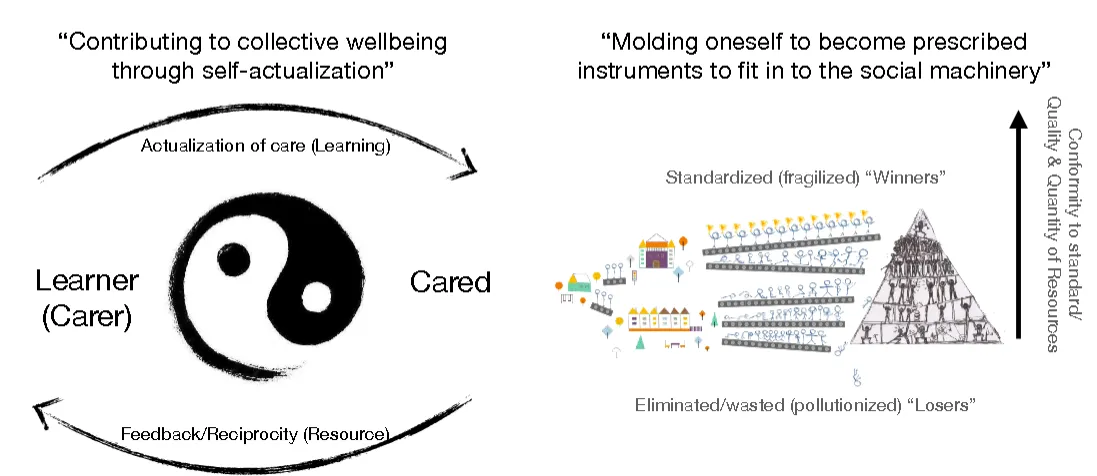
ウェンの物語を再考する:Learning by Caring(ラーニング・バイ・ケアリング)と〈配分依存〉の影響
Learning by Caring(ラーニング・バイ・ケアリング)と〈配分依存〉のメカニズムを用いて、ウェンの物語を別の文脈に置き直してみよう。
高校を辞めたことで、ウェンは偶然にも、高校による資源配分への依存を軽減した。配分の尺度――たとえば、課された形式、内容、進度、ならびに授業や高校生活のその他の側面に関する要件――に対処する負担がなければ、よりよく学べることに気づき、その結果、自律性と柔軟性が増したと感じたのである。
Reflexive Media(協働学習型メディア)のパイロット・プロジェクトへの参加は、Learning by Caring(ラーニング・バイ・ケアリング)の実用最小限の行動とみなすことができる。自分の将来への懸念と、母親の心配に応えたいという意図が、高等教育と雇用の現状を探究する動機となった。最終的に、それは知識という点だけでなく、愛情の表現としても、彼女自身と母親に価値をもたらした。それによって、彼女には、より多くの資源が互酬的に返された。たとえば、母親から受ける重圧の軽減、能力と自由の拡大、そして情緒的、実務的、その他の形態の支援である。
子どもの全人的成長へのケアと、それを促進する教育の探求は、この分野への意図的/意識的、再帰的、適応的な関与を通じて、彼女に関係する能力を高めた。同時に、その分野や大義に関与するほかの人々との関係(社会関係資本)を形成し、コミュニティの文化規範に習熟させ(文化資本)、専門職としての評判を築き(象徴資本)、さらに、人々との相互作用を通じて得た評価、給与、議論、新たな機会など、さまざまな形態のフィードバックによって、Learning by Caring(ラーニング・バイ・ケアリング)をさらに進めるための、あるいはそれ自体としての別の資源も発達させた。このような正のフィードバック・ループは、彼女自身と世界に対する学びと貢献を深め、広げ続け、彼女自身が舵を取る主体性を持つ好循環へとつながった。
図6.Learning by Caring(ラーニング・バイ・ケアリング)を体現しているときの、ウェンの能力と資産の力学(インタラクティブ・マップ)
「名門」大学からの入学許可は、彼女の貢献に対して互酬的に返された資源の一つとみなすことができる。しかし、学校へ戻り、より重要なことには、再び学校への依存に陥ったことで、彼女は苦労して築いた好循環を掌握できなくなり、徐々にその逆転へと吸い込まれていった。
彼女の経済的・心身的能力は、主として大学の配分の尺度に適合するために消費された。それにもかかわらず、大学によって配分される学習機会は、必ずしも彼女に関連するものでも、効果的なものでもなかった。とりわけ、このように競争の激しい大学では、努力が必ずしも成績やクラス順位に反映されるとは限らない。それだけでなく、象徴資本の形態としての成績や順位は、その非人格的な性格ゆえに、きわめて代替されやすい。誰であれ、より望ましい成績や順位を持つ別の人間によって代替されうるのである。所有する卒業証書に記された大学のブランドについても、同じことが当てはまる。成績、順位、さらには授業への出席という観点で、学業上の成功に最小限の努力しか払わずに済む学生もいるかもしれない。しかし、奨学金を維持するために学業成績を保たなければならなかったウェンには、そのような余裕はまったくなかった。経済的に不利な境遇にある学生のなかには成績に基づく奨学金を維持できる者もいるが、全員がそのような幸運に恵まれるわけではない。
大学の構成員とのつながりは、特に大学の「名声」を考えれば、非常に貴重な資産とみなされる。しかし、ウェンは常に完全に疲弊しており、大学で友情を築き、維持するための時間もエネルギーも実際にはなかった。仮にそうすることができたとしても、これらのつながりや、その文化規範への習熟が、将来の社会関係資本や文化資本へ転換されるとは限らない。それらは必ずしも彼女の分野に関連していないからである。これ自体は、非道具的に見れば、悪いことではない。たとえば、高等教育を「職業訓練」へと方向転換する傾向に抗して、「教育」こそ高等教育の目的であると擁護する人々の立場から見れば、そうである(たとえばPruitt, 2023を参照)。しかし、こうした関連性の欠如には留意する必要がある。これらの形態の資本の蓄積は、大学への通学が上方移動に寄与することを正当化するために、しばしば用いられるからである。
彼女には友人をつくるための十分な時間とエネルギーがなかっただけでなく、大学の負荷によって、収入を得る仕事に充てる能力も圧迫された。ましてや、思いやりを継続的に追求すること、すなわちLearning by Caring(ラーニング・バイ・ケアリング)を続けることなど到底できなかった。最終的に、大学への依存によって、彼女の人生は悪循環へと逆転した。そのなかで、心身的能力は枯渇し、経済的能力は低下し、その過程で配分された資源は、彼女の能力にとって関連性が曖昧であり、それを再生するものでもなかった。パートタイムで働くために学期ごとの単位数を減らすことは、結局のところ「失敗する解決策」となった。最終的に卒業証書を得ることを期待しながら、悪循環へ吸い込まれ続ける状況を長引かせたからである。しかし不幸にも、卒業へ到達する前に彼女の能力は枯渇した。
この観点からすれば、大学が約束した上方移動は、彼女にほとんどすべてを失わせた失敗した賭け以外に、いったい何を与えたのだろうか。
図6.2.選抜性の高い大学に通っているときの、ウェンの能力と資産の力学(インタラクティブ・マップ)
精緻化するシステム「モデル」、消滅するシステム「思考」:機械論的閉鎖システムの実証主義的再生産
ウェンの物語は、既存の学校教育システムと、広く流布している教育観に対する生きた批判である。同時に、システム変革とリーダーシップ全般に対する警告の物語でもある。
「貧しい子どもを(良い)大学へ入れる」という例は、現在広く普及しているシステム思考、システム・リーダーシップ、システム変革のアプローチが持つ、次のような論理を典型的に示している。すなわち、システム思考の実践を、さまざまな要因とそれらの動的な相互作用を考慮することによって、根本原因とそのレバレッジ・ポイントを特定する過程とみなす。システム・リーダーシップを、人々の局所的な洞察を取り入れ、より大きな全体像をともに見られるようにし、その共有されたビジョンや知識に基づいて集合的に意思決定し、実行することとみなす。そして、システム変革を、上記の過程に基づいて特定されたレバレッジ・ポイントに取り組む、社会全体のコミットメントとみなすのである。
しかし、ウェンの事例は、システムを理解するための基礎データやエビデンスが純粋に実証主義的であるなら、実施されるシステム的介入が、システム的思考がそもそも批判し変革しようとした機械論的閉鎖システムと、その抑圧的帰結へと回帰する危険があることを示している(Adorno & Horkheimer, 1997; Bhaskar, 2008; 2009も参照)。この物語では明示的に論じられていないものの、そこから示唆されるのは、集合的意思決定には価値がある一方で、システム・リーダーシップと変革へのこのようなアプローチは、依然として非常にトップダウンなものになりうるということである。ただし、集合体がトップへアクセスでき、参加することによってトップを正当化するという違いがあるにすぎない。
データによるものであれ、意思決定過程によるものであれ、特定されたレバレッジ・ポイントが、たとえばKPIという形でいったん固定されると、関心対象のシステムもまた、その特定の時空間に人為的に凍結され、機械論的閉鎖システムとなる。有機的かつ開放的であることをやめるからである。そのような物象化された見方からは見えない盲点や影* (物象化についてのより深い議論はBhaskar(2009)を参照) は、不正義やあらゆる種類の社会問題、そして現実の人々の苦痛と被害の温床となる。ウェンの事例は、大学卒業と上方移動との相関関係を覆すものではない。しかし彼女の物語は、低所得の若者を大学に入学させることが_唯一のレバレッジ・ポイント_として扱われるとき、意図されない苦痛や被害が生じうることを示している。Cabrera、Cabrera、Midgleyによる、システム思考の初期の波への批判と、その再定義[2023]を踏まえるなら、システムについての人のメンタル・モデルが適応をやめた時点で、そのモデルがどれほど精緻にシステムを記述していようとも、それはもはやシステム「思考」ではない。
批判的実在論に基づくエージェント・ベースのアプローチ:自らが「変化となる」ために、私たちが従って生きるルールを変える
〈配分依存〉とLearning by Caring(ラーニング・バイ・ケアリング)は、システム思考、リーダーシップ、変革に対する異なるアプローチの例である。このアプローチは、批判的実在論と呼ばれる科学哲学の一分野と、エージェント・ベースのアプローチと呼ばれるシステム方法論を組み合わせるものである(以下「ABA」とする。Oktavia Mulyono, Sukhbaatar and Cabrera, 2023; Wen et al., 2023を参照)。
批判的実在論は、互いに衝突するビリヤード球のように作用する事象の連鎖に原因を求めるのではなく、因果的力能を持つ基底的メカニズム、すなわち、ビリヤード球が衝突することによって互いを動かす力を持つのは何によるのかを探求する(Bhaskar, 2008)。たとえば、「なぜドアが開いているのか」と問うとき、「それを開ける行為」のように、その状況に先行した事象は、批判的実在論者にとってあまり満足のいく答えではない。批判的実在論者は、「どのような構造的特徴が、物理法則との関係において、ドアを開けることを可能にしているのか」といった側面を探究し、より深く掘り下げようとする。本稿の文脈では、「上方移動」を「大学への通学」に帰属させることは、「開いたドア」の原因を、それに先行する行為に帰属させることに等しい。それに対して、ウェンの経験において作用した〈配分依存〉とLearning by Caring(ラーニング・バイ・ケアリング)を、高等教育それ自体に責任を帰すことなく検討することは、構造を実際に構成するものが大学であれ、ほかの何かであれ、どのような構造的特徴が彼女の自己実現を阻害し、あるいは可能にしたのかを理解しようとすることである。
一方で、ABAは、基底的メカニズムを探す際に何へ焦点を当てるべきかを示唆する。すなわち、複雑適応系が、単純なルールやパターンに基づいて相互作用する行為主体から創発するのであれば、関心またはケアの対象となる現象の基底には、どのような単純なルールやパターンが存在するのか、という問いである。アリのコロニーは、特定の「アリの指導者」の命令――先行事象の一種――によって形成されるのではなく、フェロモンの放出と追跡に関する単純なルールに従う多数のアリから創発する。同様に、〈配分依存〉とLearning by Caring(ラーニング・バイ・ケアリング)の因果的力能はいずれも、人々がそれぞれの単純なルールに従うことから創発する。そのルールとは、すなわち、「自分が依存する配分済み資源を、配分の尺度に適合することで換金する」と、「自分がケアするものに注意を向け、フィードバックを、さらにケアし/学び/成長するための資源とする」である。〈配分依存〉に従うことは、疎外、不平等、枯渇、脆弱性などの有害な創発特性につながる。Learning by Caring(ラーニング・バイ・ケアリング)に従うことは、互酬的行為を通じて資源の再生を開始することにより、資源配分への依存を軽減する。
批判的実在論は、望ましい「従属変数」が生じることを期待して、主要な「独立変数」を特定し置き換える実証主義的なシステム介入のアプローチが、実際には、機械論的閉鎖システムの非人間化する構造を再生産しうることを示している。むしろ、実質的な変革が起こるためには、特定の先行事象だけを切り出すのではなく、作用している基底的構造とメカニズムを深く理解しなければならない。
Marxは有名な言葉を残している。「人間は自らの歴史をつくる。しかし、思うままにつくるのではない。自ら選んだ状況のもとでつくるのではなく、すでに存在し、過去から与えられ、伝えられた状況のもとでつくるのである。」私たちが生まれ落ちる構造とメカニズムは、自ら選んだものではない。しかし、複雑適応系理論が示すように、これらの構造やメカニズムの多くは、特定の事象や、しばしば強大だが邪悪で腐敗していると描かれる行為主体によって、単に外部から押しつけられているのではなく、単純なルールに基づいて相互作用する行為主体によって、実際には自己組織化され、維持されている。ABMを用いることで、私たちは、有害な構造とメカニズムを維持するルールを特定し、理解するよう努めることができる。
このような、より深いシステム思考と覚知があれば、私たちは、システムを変えるために、次の公聴会、抗議運動、技術的ブレークスルー――もちろん、これらの行動は異なる側面において重要であり、引き続き行うことができる――や、それらに対する政府の対応を待つ必要はもはやない。システムの網の目のどこにいようとも、私たちが従って生きるルールを変えるために行動することによって、システム・リーダーシップと変革は創発しうる。それによって、「私たちが世界に見たい変化そのものとなる(その変化を導く)」のである。Gandhiによる元の表現では、「私たちが自分自身を変えられれば、世界の傾向もまた変わるだろう。人が自らの性質を変えるとき、その人に対する世界の態度も変わる。……私たちは、他者が何をするかを見るまで待つ必要はない」のである。
参考文献
Adorno, T.W., Horkheimer, M., 1997. Dialectic of enlightenment(啓蒙の弁証法). Verso.
Arrow, K.J., 1973. Higher education as a filter(フィルターとしての高等教育). Journal of Public Economics 2, 193–216. https://doi.org/10.1016/0047-2727(73)90013-3
Becker, G.S., 1994. Human Capital: A Theoretical and Empirical Analysis with Special Reference to Education, Third Edition(人的資本――教育を中心とした理論的・実証的分析、第3版).
Bhaskar, R., 2016. Enlightened Common Sense(啓発された常識). Routledge. https://doi.org/10.4324/9781315542942
Bhaskar, R., 2009. Plato Etc: The Problems of Philosophy and their Resolution(プラトンほか――哲学の諸問題とその解決), 1st edition. ed. Routledge, London.
Bhaskar, R., 2008. A Realist Theory of Science(科学の実在論的理論). Routledge, London ; New York.
Bourdieu, P., 2018. The forms of capital(資本の諸形態), in: The Sociology of Economic Life(経済生活の社会学). Routledge, pp. 78–92.
Bourdieu, P., 1989. Social space and symbolic power(社会空間と象徴権力). Sociological theory 7, 14–25.
Bourdieu, P., 1979. Symbolic Power(象徴権力). Critique of Anthropology 4, 77–85. https://doi.org/10.1177/0308275X7900401307
Cabrera, D., Cabrera, L., Midgley, G., 2023. The Four Waves of Systems Thinking(システム思考の四つの波). Journal of Systems Thinking 1–51. https://doi.org/10.54120/jost.000051
Directorate General of Budget, Accounting and Statistics, 2024. Unemployment Rate-Educational Attainment(失業率――教育達成別).
Ha-Joon, C., 2022. Eating Economics Better(経済学をよりよく味わう) [基調講演]. Khazanah Megatrends Forum, Kuala Lumpur. https://youtu.be/vxyohp8carA?si=HIalraslJEwUOFef
Mincer, J.A., 1974. Schooling, Experience, and Earnings(学校教育、経験、所得).
Oktavia Mulyono, Y., Sukhbaatar, U., Cabrera, D., 2023. ‘Hard’ and ‘Soft’ Methods in Complex Adaptive Systems (CAS) : Agent Based Modeling (ABM) and the Agent Based Approach (ABA)(複雑適応系(CAS)における「ハード」および「ソフト」な方法――エージェント・ベース・モデリング(ABM)とエージェント・ベースのアプローチ(ABA)). Journal of Systems Thinking 1–33. https://doi.org/10.54120/jost.000009
Pruitt, G. A. (2023) ‘You Do Not Go to College to Get a Job, You Go to College to Get an Education’(「仕事を得るために大学へ行くのではない。教育を得るために大学へ行くのである」), HigherEd Jobs, 23 August. 閲覧先:https://www.higheredjobs.com/blog/postDisplay.cfm?post=3590&blog=39(閲覧日:25 May 2024).
Schultz, T.W., 1961. Investment in Human Capital(人的資本への投資). The American Economic Review 51, 1–17.
Spence, M., 1973. Job Market Signaling(労働市場のシグナリング). The Quarterly Journal of Economics 87, 355–374.
Stiglitz, J.E., 1975. The theory of” screening,” education, and the distribution of income(「スクリーニング」、教育、所得分配の理論). The American economic review 65, 283–300.
Swahill, I. (2013) ‘Higher Education and the Opportunity Gap’(「高等教育と機会格差」), in How College Shapes Lives: Understanding the Issues(大学はいかに人生を形づくるか――問題の理解). CollegeBoard. 閲覧先:https://www.brookings.edu/articles/higher-education-and-the-opportunity-gap/(閲覧日:26 May 2024).
Wen, A., Hock, A., Carver, B., Ortega, A., Corsi, P., Jordan, J., Nicholson, A.M., Cabrera, L.Y., Cabrera, D., 2022. Framework Effectiveness and Prevalence in Public Policy : A survey of the field and a discussion of the need for an agent based systems approach(公共政策における枠組みの有効性と普及――分野の概観と、エージェント・ベースのシステム・アプローチの必要性に関する考察). Journal of Systems Thinking 2, 1–29. https://doi.org/10.54120/jost.000060
楊逸帆 [Yang, A.], 2023a. 分割された文明難局を複雑適応系のアプローチで繋げる:〈自己家畜化論〉と〈自己完結社会論〉を踏まえた〈配分依存論〉の試み [Connecting the Compartmentalized Civilizational Predicaments: A Complex Adaptive Systems-Based Approach Through the Allocation Dependence Theory]. https://doi.org/DOI: 10.13140/RG.2.2.32677.68322
Yang, A., 2023b. Discovering “Allocation Dependence” in the Persistence of “Diplomaism” in Taiwan: An Attempt to Uncover Common Mechanisms Underlying Wicked Problems(台湾における「学歴主義」の持続のなかに〈配分依存〉を見いだす――厄介な問題の基底にある共通メカニズムの解明の試み). Presented at the International Association for Critical Realism, Manila.
楊逸帆 [Yang, A.], 2021a. 配分依存:全人的発達を抑制する生成メカニズム [Allocation Dependence: A Generative Mechanism that Inhibits the Pursuit of Holistic Development]. 総合人間学 [Synthetic Anthropology] 15, 39–59.
Yang, A., 2021b. What if the “Disadvantaged” are already the most “Resource Abundant?” A case for shifting from “Forecast-based” to “Agent-based” talent incubation(「不利な立場にある人々」が、すでに最も「資源に恵まれた」人々であるとしたら――「予測ベース」から「エージェント・ベース」の人材育成への転換を求める議論). https://doi.org/10.13140/RG.2.2.18626.66245
Yang, A., 2020. Transformation of a System Begins With Transforming the Way We Live(システムの変革は、私たちの生き方を変革することから始まる). https://doi.org/10.13140/RG.2.2.18963.14888
楊逸帆 & 閉恩濡 [Yang, A., Pi, E.-J.], 2012. 以「行動導向媒體」回應兩大教育問題 [Addressing two major challenges in education with the aid of “Action-oriented Media”]. Presented at the 2012 Taiwan Social Entrepreneurship Forum, Taipei. https://doi.org/10.13140/RG.2.2.35348.68487
原文を読む
An “accidental freedom” from school…
Without university, Wen* (This is a pseudonym, and some personal information are changed to protect the individual’s privacy) used to thrive as a professional. However, entering university dragged her back to the brink of a poverty trap.
Raised in a single-parent, low-income family, Wen has always been diligent and considerate. She studied hard enough to enter one of the better high schools in her city and kept getting good grades under high competition and pressure. However, everything changed when her grandfather got into an accident and she left high school to become his caregiver.
Leaving school due to family financial difficulties may sound like a recipe for teen pregnancy, drugs, and crime, but the opposite was true for Wen. She found learning more effective and relevant when she was fully in charge. Besides taking care of her grandfather, her compassion for children made her stand out from other university students at selective universities and got her accepted for a paid tutoring job offer.
She enjoyed her “self-directed education,” her job, self-actualization, autonomy, and flexibility in her new lifestyle. Despite the physical burden, caring for her grandfather wasn’t merely draining but was also fulfilling. Her bond with her grandfather is deep, and she enjoyed chatting with him.
But as time went by, the question of her future lurked. Her mother wanted her to return to school and get into university, even if it would be a substantial financial burden to the family.
Wen faced a dilemma. She found that learning independently was way more cost-effective than returning to school, and she wasn’t sure what she would study at university yet. She didn’t want to bring such a substantial financial burden to her mother for nothing. But at the same time, she didn’t want to make her mother worry; she was also concerned that the decision not to attend university might significantly impact her life negatively.
Wen brought her dilemma to the Awakening Cooperative Lab and explored it through our pilot project on “Reflexive Media” (Yang and Pi, 2012; Yang, 2020). The project is based on a model in which the audience-learners crowdsource the issues they want to cover and then engage in shared inquiry together. In this approach, media content becomes a product of intersubjective and reflexive learning instead of single-directional “feeding” of information –the standard spoon-feeding model of education (Figure 1).
At the time, the project’s focal issue was the relationship between higher education and employment. By joining interviews with job market professionals, learning about the oversupply of university-level jobseekers; interviewing professionals without university degrees, learning from their own experiences of (self-)education at workplaces; and studying the phenomenon of “overeducation” and “underemployment,” Wen found herself wanting to explore her passion for education further at the workplace before attending university. She brought a copy of Awakening Magazine — which summarized the output of their collective inquiry — to her mother. Reassured by the thorough study that Wen had participated in, her mom approved Wen to go directly to work (Figure 2.1. and 2.2.).
Starting as an afterschool program teacher, Wen’s passion, hard work, and attentiveness to the child as a whole person, rather than just academic performance, quickly got her promoted to the leadership level at the afterschool program. Shortly after, her reputation at work got her an invitation to join as a founding member of an alternative school. At the same time, her story became an encouragement to many. She began receiving public speaking invitations and was ultimately awarded the Presidential Education Award for her contribution to education.
…and an “unexpected fall” after her return
After years of exploration through practice, she became certain that she wanted to pursue education and believed that, in the long run, to become a credible educator (especially given the social norms of becoming so), getting a higher degree would still be better.
Her portfolio got her accepted into one of Taiwan’s most selective universities without any entrance exams. Given her socioeconomic background and the gap between her high school and university’s selectivity, returning to her community high school and applying through the traditional exam route would have been nearly impossible.
Getting into a “prestigious” university as a disadvantaged yet high-achieving youth may sound like a guarantee for successful upward mobility. However, Wen’s life, like the lives of many students worldwide, defied common conception. Her university life was packed with irrelevant (e.g., outdated compared to her years of pioneering practice) courses just to meet the graduation requirements, with few exceptions. To keep receiving merit-based scholarships, a considerable portion of her afterschool time had to be spent on academics so that her grades and class ranking wouldn’t fall behind, especially since her university was one of the most competitive in the country. However, besides university, she still needed a job to support herself and her family financially. Given the heavy school workload, she couldn’t continue her full-time alternative school job in another city; she only took highly replaceable and repetitive part-time assistant jobs that didn’t just pay poorly but also weren’t positions in which her abilities and personality could truly bring value. A lower wage means more work hours to meet her financial needs, yet her university requirements imposed a tight cap on her work hours. Ironically, while she entered university to pursue her passion for education better, it turned out to be anything but that. She was physically and mentally exhausted by the way of life that the university imposed on her without any room to further the professional development of her passion — learner-centered, holistic education.
Wen had to reduce her credit load each semester to work enough hours to meet her personal and family financial needs. Extracurricular or spontaneous student activities — another crucial asset supposed to be provided by university life — were never in the picture due to her limited time and energy. Yet, the income from the extended working hours was still way below the level of a full-time job. Overworking for both her academics and part-time job undermined her health, and the delayed graduation due to insufficient credits worsened this toxic situation by prolonging it. Ultimately, her health broke down after years of burnout. She couldn’t attend university anymore. At the same time, given her health situation, she had to earn more with fewer working hours, meaning returning to work in alternative education wasn’t feasible.
Without many options, she left education altogether.
She changed her profession — She became an aromatherapist and beautician for income and time for self-care.
“Getting poor kids into (good) universities” — an evidenced-based leverage point?
Confronting the mainstream, “science/evidence-based,” and “systematic approach” to poverty reduction (e.g., see Banerjee and Duflo, 2012), which stresses the importance of (higher) education as a necessity for upward mobility and the betterment of society, Wen’s story might sound like an anomaly. However, if we closely examine this rationale and Wen’s story, we will find that the reality of learning, education, social mobility, and inequality is always more nuanced than the seemingly objective numbers.
For simplicity, we can summarize the assumptions underlying the view of “higher education as a key solution to poverty” or “getting poor kids into (good) universities” with the following positive feedback loop (Figure 3).
- More or better schooling
- builds more or better skills and knowledge, improves decision-making (associated with the human capital view; See: Becker, 1994; Mincer, 1974; Schultz, 1961),
- accumulates more or better cultural, social, and symbolic capital (associated with the social and cultural reproduction view; See: Bourdieu, 1979; 1989; 2018),
- and signifies higher desirability as an employee (associated with the signaling view ; See: Arrow, 1973; Spence, 1973; Stiglitz, 1975).
- These all contribute to access to more advanced career options or life opportunities, which are assumed to be associated with more significant income.
- A higher income allows one to afford more or better schooling for oneself or one’s offspring, reinforcing the feedback loop.
- Granting disadvantaged youth a “good education” (e.g., enrollment at and financial support for attending a “good” university) seeks to break away from the youth’s limiting socioeconomic background, giving them an equal starting point to enter such a positive cycle with their effort (e.g., see Banerjee and Duflo, 2012).
However, the paper or digital copy of one’s diploma in itself isn’t very useful. While school attainment***** (This is often called “educational attainment.” However, following Illich’s (1971) argument that “more years in school” or “completing studies at more advanced levels of schools” isn’t necessarily equal to “more education,” I choose to use “school attainment” instead) is a useful concept for understanding this causal relation, it is evident that neither the capability, different forms of capital, nor the desirability as an employee can be reduced to the effects of obtaining that piece of diploma. These assumed benefits are the results of many other major factors, including but not limited to how time is spent during the years of schooling, the supply and demand of talent under the society’s economic structure, or regulations on income, taxes, and so on, which, although playing significant roles in this picture, are still subject to the webs of causation as a feature of open systems. For example, influenced by an oversupply of talent, university graduates in Taiwan face the lowest job opportunities at their school attainment level and the highest unemployment rate compared to people with lower school attainments (Directorate General of Budget, Accounting and Statistics, 2024; Yang 2021a).
A mechanism that stifled Wen: Allocation Dependence
To make sense of Wen’s story further, two concepts, or understanding two systemic mechanisms, are crucial.
The first is Allocation Dependence (Yang 2021a; 2023a; 2023b). It describes the mechanism at play when agents are dependent on allocated resources, thereby focusing on redeeming such resources by their “monetized qualities” after a process that assimilates and trims off their qualities mainly to fit into the allocation measures (e.g., criteria, means, processes) rather than the intrinsic value or meaning of doing so. In other words, when a person is allocation-dependent, they focus on changing themself in a transactional manner, under the assumption that the better/more they fit in the allocation measures, the better/more resources they can get from the resource allocation process or system.
In the context of education, this mechanism is often observable when students (although not unusually forced by their parents or teachers) are dependent on resource allocation by educational institutions (e.g., schools, universities, and the tracking/accountability/etc. systems that weave them together), such as the opportunity to increase one’s capability and different forms of capital: Before the next stage of schooling, students have to equip themselves with what gives them an edge to get into a “good” school/university and may have to let go of some activities, passions, or traits that might get in the way. Similarly, to receive resources such as grades, certificates, scholarships, eligibility for specific programs, or the diploma, students must meet the prerequisites, which, given that time and energy are limited, is often at the cost of developing themselves in other directions.
Entailed in this mechanism are many emergent problems. I’ll only mention a few here:
- Given every individual’s distinct characteristics (e.g., backgrounds, traits, dispositions), when put under a common set of measures, there will always be some who fit the measures better than others. In other words, this mechanism already involves inequality (Figure 4.2.).
- At the same time, as the focus and effort are directed toward “meeting” the allocation measures to “redeem” resources, the allocation-dependent agent ceases to “regenerate” resources but only “ exchange ” (often in some form of competition) for an assumingly existing and functional pool of resources (Figure 4.3.).
- However, hard work doesn’t guarantee a good fit with the allocation measure; a good fit with the allocation measure doesn’t necessarily guarantee the successful redemption of resources (e.g., because of other “equally good fits”); the successful redemption of resources doesn’t guarantee the resources’ utility or value given the agent’s context (e.g., a higher degree doesn’t necessarily bring better career opportunities since the society/economic structures are also changing) — in other words, falling into this mechanism increases the fragility of the agent, as any section of the chain of contingencies such as the above fails to work, the entire system also fails to work (Figure 4.4.).
We can picture a world where all people are allocation-dependent:
- Institutions exploit resources and allocate them to people;
- People change themselves (at times in alienating ways) to compete for resources, then they occupy the allocated resources, consume them, and waste the unused resources;
- People who fail the competition are left behind with minimal or no resources, often disempowered;
- Any unexpected failure in the chain of contingencies harms real lives; and
- Since most people are solely focused on getting resources and the regeneration of resources is not an embedded necessity of life, the speed of exhaustion greatly exceeds the regeneration of resources.
A mechanism that empowered Wen: Learning by Caring
Learning by Caring, the second mechanism, is an educational approach that can alleviate or mitigate one’s allocation dependence — at least in the context of education/learning and social relations. In comparison but not against the existing two ideal paradigms of education — Learning by Reasoning (e.g., critical thinking, liberal arts) and Learning by Doing (e.g., hands-on/experiential learning, project-based learning, vocational education), Learning by Caring is inclusive of both but additionally addresses the question of educational resources by tapping into the power of reciprocity as a social form of regeneration — Instead of mere consumption and exhaustion of resources after being allocated, resources or values are regenerated when reciprocated.
Learning by Caring happens when one cares about something(s) and tries to attend to the cared (e.g., a thing, an issue or cause, a person, etc.). By attending to the cared, the learner is deliberately or consciously, reflexively, and adaptively broadening and deepening their awareness of themselves and the cared thing(s). Hence, they become able to respond to both. This involves but also goes beyond both Learning by Reasoning and Doing. Such holistic engagement with the cared and themself in itself is already a process of and a resource for building the learner’s capacity. In contrast to the typical learning directed and appraised by prescribed goals/content, which inevitably makes some learners get ahead and leaves others behind, in Learning by Caring, every learner’s distinct background, aptitude, experiences, etc., become their unique asset — even if everyone has different starting points. Since they’re each pursuing their unique pathways of caring, nobody is ahead or left behind — they all, equally, move forward from where they are.
Additionally, as caring is a socially embedded activity, the learner will also interact with people involved with the cared or who share related concerns. The responses from these people, whether positive or negative, friendly or unfriendly, material or nonmaterial, are also already resources for the learner’s further learning, as such feedback is a source for the learner’s adaptation or growth in different areas. At the same time, interactions with people provide the conditions for building “relevant” social capital and cultural capital — i.e., by building connections, familiarity, trust, etc., and embodiment of cultural norms in a community relevant to the learner’s further development and career. While it is important to note that Learning by Caring per se doesn’t guarantee future income or financial sustainability, as contributions or value created to others and society often aren’t fairly represented in monetary terms* (As economist Ha-Joon Chang (2022) said , the “key/essential workers” whose utmost importance for our survival was recognized under the impact of the COVID-19 pandemic, ironically get paid almost the least under the so-called “free market economy”), money or employment are still possible means for others to reciprocate the learner’s care. In this scenario, Learning by Caring also increases learners’ financial capacity to further their learning.
Wen’s story revisited: The impacts of Learning by Caring and Allocation Dependence
Let’s try to recontextualize Wen’s story with the mechanisms of Learning by Caring and Allocation Dependence.
By leaving high school, Wen accidentally alleviated her dependence on the resource allocation by her high school — She found that she was able to learn better without the burden of coping with the allocation measures (e.g., the imposed format, content, pace, and other requirements concerning instruction and other aspects of high school life), therefore the experienced increased autonomy and flexibility.
Her participation in the Reflexive Media Pilot can be considered a minimal viable action for Learning by Caring. Her concern for her future and the intent to address her mother’s worry motivated her to inquire about the state of higher education and employment. Eventually, it brought value to herself and her mother not only in terms of knowledge but also as an expression of love. By that, she was reciprocated with more resources (e.g., reduced burden from her mother; more capacity and freedom; and emotional, logistic, or other forms of support).
Her care for children’s holistic growth and the quest for the kind of education that facilitates that, increased her relevant capacities through deliberate/conscious, reflexive, and adaptive engagement in the field, and at the same time, built relationships with other people involved in the field or cause (social capital), familiarized her with the cultural norms of the community (cultural capital); built her reputation as a professional (symbolic capital); and developed other resources for her further Learning by/as Caring through the different forms of feedback, such as appraisal, salary, discussions, and new opportunities that she received from the people she interacted with. Such a positive feedback loop continued to deepen and broaden her learning and contributions to herself and the world, leading to a virtuous cycle in which she had the agency of steering.
The offer by the “prestigious” university can be considered one of the resources reciprocated to her contributions. However, by returning to, and more importantly, falling back into the dependence on school, she began to lose her grip on the virtuous cycle she worked hard to establish, gradually sucked into its reversal.
Her financial and psycho-physical capacity is primarily consumed by fitting into the allocation measures of the university. Yet, the learning opportunities allocated by the university aren’t necessarily relevant or effective. Not only does hard work not necessarily get represented in grades and class rankings, especially in such a highly competitive university, but grades and ranking as forms of symbolic capital are highly replaceable due to their impersonal nature — Anyone is replaceable by another who has more desirable grades or rankings. The same applies to the university brand on the graduation certificate one possesses. While some students might be able to put minimal effort into their academic success in terms of grades and rankings or even class attendance, Wen never had this luxury, as she had to keep up with her academic performance to keep her scholarship — Although some economically disadvantaged students can keep up with merit-based scholarships, not all of them have such luck.
While the connections with members at the university are considered invaluable assets, especially given the university’s “prestige,” Wen had always been so completely exhausted that she never really had the time and energy to make and maintain friendships at the university. Even if she could do so, these connections and the familiarity with their cultural norms do not necessarily translate into future social and cultural capital, as they aren’t necessarily relevant to her field. This in itself isn’t a bad thing if viewed non-instrumentally, for example, in the line of those who defend “education” as higher education’s purpose against trends redirecting it towards “vocational training” (e.g., see Pruitt, 2023). However, such irrelevance is necessary to note because the accumulation of these forms of capital is often used to justify university attendance’s contribution to upward mobility.
Not only did she not have enough time and energy to make friends, but the university loading also squeezed her capacity for income-generating work, not to mention her continual pursuit of compassion or Learning by Caring. Ultimately, her dependence on the university reversed her life into a vicious cycle in which her psycho-physical capacity became depleted, her financial capacity reduced, and the allocated resources during the process were only vaguely relevant or regenerative of her capacities. Cutting down credits per semester for part-time work turned out to be a “fix that fails,” as it prolonged the situation of being sucked into the vicious cycle in the hope of finally getting the graduation certificate. Still, unfortunately, her capacity was depleted before she could reach graduation.
From this perspective, what did the university’s promise of upward mobility give her besides a failed gamble that cost her almost everything?
Sophisticated systems “models,” disappearing systems “thinking”: Positivistic reproduction of mechanistic closed systems
Wen’s story is a living critique of the existing schooling system and the widespread conceptions about education. At the same time, it is also a cautionary tale to systems change and leadership in general.
The “getting poor kids into (good) universities” example exemplifies the following rationale of the existing popular systems thinking, systems leadership, and systems change approach: It considers the practice of systems thinking as a process of identifying root causes and their leverage points by taking various factors and their dynamic interactions into account; systems leadership as bringing people to see such a bigger picture together by bringing in their local insights, and making, executing decisions collectively based on such shared vision or knowledge; and systems change as the commitment of society as whole to tackle the identified leverage points based on the processes above.
However, Wen’s case shows that if the underlying data or evidence for the understanding of systems is purely positivistic, there is a danger of the deployed systemic intervention reverting to the mechanistic closed system and its oppressive consequences that systemic thought set for the critique and transform in the first place (see also Adorno & Horkheimer, 1997; Bhaskar, 2008; 2009). Not discussed but implied by the story is that while collective decision-making has its value, such an approach to systems leadership and change can still be very top-down — just that the collective has access to the top and legitimizes it by participating.
Either due to the data or decision-making process, once the identified leverage points become fixed, for example, in the forms of KPIs, the system of interest also becomes artificially frozen at that specific time-space, thus becoming a mechanistic closed system (for it ceases to be organic and open). The blind spots and shadows unseeable from such reified views* (For a deeper discussion on reification, see Bhaskar (2009)) become hotbeds for injustice and all kinds of social problems, as well as suffering and harm to real lives. Wen’s case doesn’t overturn the correlation between university completion and upward mobility. However, her story shows that unintended suffering and harm may arise when low-income youth’s university enrollment is treated as The Leverage Point. Building upon Cabrera, Cabrera, and Midgley’s critique of earlier waves of systems thinking and their redefinition of it (2023), once one’s mental model of a system ceases to adapt, no matter how sophisticated the model describes the system, it ceases to be systems “thinking” at all.
Critical Realism-informed Agent-Based Approach: Changing the rules we live by to “be the change”
Allocation Dependence and Learning by Caring are examples of a different approach to systems thinking, leadership, and change, which combines a branch of philosophy of science called Critical Realism and a systems methodology called Agent-Based Approach (Hereafter as “ABA.” See Oktavia Mulyono, Sukhbaatar and Cabrera, 2023; Wen et al., 2023).
Critical realism seeks causes not in the sequences of events that act like billiard balls that bump into each other but in underlying mechanisms that have causal powers or what makes billiard balls have the power to move one another by bumping each other (Bhaskar, 2008). For example, when asking “why a door is opened,” the event preceding the situation, such as “the act of opening it,” isn’t a very satisfactory answer to critical realists. Critical realists try to dive deeper by exploring aspects such as “What structural features (and their relations to physical laws) enable the door to be opened?” In the context of this article, attributing “upward mobility” to “university attendance” is like attributing the cause of an “opened door” to its preceding act. In contrast, the examination of Allocation Dependence and Learning by Caring at play in Wen’s experience, without blaming higher education per se, is to understand what structural features inhibit or enable her self-actualization, whether the actual component of the structure is a university or something else.
On the other hand, the ABA hints at what to focus on when looking for underlying mechanisms: Given that complex adaptive systems emerge from agents that interact based on simple rules or patterns, what are the simple rules or patterns underlying the phenomenon of interest or caring? An ant colony isn’t built under the command (a type of preceding event) of any specific “ant leader(s),” but from the emergence of a large number of ants following the simple rules related to pheromone release and trailing. Likewise, the causal powers of Allocation Dependence and Learning by Caring are both emergent from people following the respective simple rules, namely, “redeem allocated resources that I’m dependent upon by fitting into the allocation measures,” and “attend to what I care about and take feedbacks as resources to care/learn/grow further.” Following Allocation Dependence leads to detrimental emergent properties such as alienation, inequality, exhaustion, and fragility. Following Learning by Caring reduces one’s dependence on resource allocation by initiating resource regeneration through reciprocal action.
Critical realism shows us that the positivistic approach to systemic intervention, which identifies and replaces key “independent variables” in the hope that desired “dependent variables” arise, may actually reproduce the dehumanizing structures of mechanistic closed systems. Instead, for substantial change to happen, we must deeply understand the underlying structures and mechanisms at play, instead of just singling out specific preceding events.
Marx famously said, “Men make their own history, but they do not make it as they please; they do not make it under self-selected circumstances, but under circumstances existing already, given and transmitted from the past.” While the structures and mechanisms we are born in are not self-selected, complex adaptive systems theory shows us that many of these structures and mechanisms are actually self-organized and sustained by agents that interact based on simple rules, rather than merely imposed externally through certain events or (often portrayed powerful but evil and corrupted) actors. With ABM, we can strive to identify and understand the rules that sustain detrimental structures and mechanisms.
With such deeper systems thinking and awareness, we no longer have to wait for the next public hearing, protest, technological breakthrough (of course, these actions are essential in different aspects and could still be done), and the governmental responses to them to change the system. Wherever we are in the web of systems, systems leadership and change can emerge by taking action to shift the rules we live by, thereby “being (leading) the change we want to see in the world.” In Gandhi’s original version, “If we could change ourselves, the tendencies in the world would also change. As a man changes his own nature, so does the attitude of the world change towards him. … We need not wait to see what others do.”
References
Adorno, T.W., Horkheimer, M., 1997. Dialectic of enlightenment. Verso.
Arrow, K.J., 1973. Higher education as a filter. Journal of Public Economics 2, 193–216. https://doi.org/10.1016/0047-2727(73)90013-3
Becker, G.S., 1994. Human Capital: A Theoretical and Empirical Analysis with Special Reference to Education, Third Edition.
Bhaskar, R., 2016. Enlightened Common Sense. Routledge. https://doi.org/10.4324/9781315542942
Bhaskar, R., 2009. Plato Etc: The Problems of Philosophy and their Resolution, 1st edition. ed. Routledge, London.
Bhaskar, R., 2008. A Realist Theory of Science. Routledge, London ; New York.
Bourdieu, P., 2018. The forms of capital, in: The Sociology of Economic Life. Routledge, pp. 78–92.
Bourdieu, P., 1989. Social space and symbolic power. Sociological theory 7, 14–25.
Bourdieu, P., 1979. Symbolic Power. Critique of Anthropology 4, 77–85. https://doi.org/10.1177/0308275X7900401307
Cabrera, D., Cabrera, L., Midgley, G., 2023. The Four Waves of Systems Thinking. Journal of Systems Thinking 1–51. https://doi.org/10.54120/jost.000051
Directorate General of Budget, Accounting and Statistics, 2024. Unemployment Rate-Educational Attainment.
Ha-Joon, C., 2022. Eating Economics Better [Keynote speech]. Khazanah Megatrends Forum, Kuala Lumpur. https://youtu.be/vxyohp8carA?si=HIalraslJEwUOFef
Mincer, J.A., 1974. Schooling, Experience, and Earnings.
Oktavia Mulyono, Y., Sukhbaatar, U., Cabrera, D., 2023. ‘Hard’ and ‘Soft’ Methods in Complex Adaptive Systems (CAS) : Agent Based Modeling (ABM) and the Agent Based Approach (ABA). Journal of Systems Thinking 1–33. https://doi.org/10.54120/jost.000009
Pruitt, G. A. (2023) ‘You Do Not Go to College to Get a Job, You Go to College to Get an Education’, HigherEd Jobs, 23 August. Available at: https://www.higheredjobs.com/blog/postDisplay.cfm?post=3590&blog=39 (Accessed: 25 May 2024).
Schultz, T.W., 1961. Investment in Human Capital. The American Economic Review 51, 1–17.
Spence, M., 1973. Job Market Signaling. The Quarterly Journal of Economics 87, 355–374.
Stiglitz, J.E., 1975. The theory of” screening,” education, and the distribution of income. The American economic review 65, 283–300.
Swahill, I. (2013) ‘Higher Education and the Opportunity Gap’, in How College Shapes Lives: Understanding the Issues. CollegeBoard. Available at: https://www.brookings.edu/articles/higher-education-and-the-opportunity-gap/ (Accessed: 26 May 2024).
Wen, A., Hock, A., Carver, B., Ortega, A., Corsi, P., Jordan, J., Nicholson, A.M., Cabrera, L.Y., Cabrera, D., 2022. Framework Effectiveness and Prevalence in Public Policy : A survey of the field and a discussion of the need for an agent based systems approach. Journal of Systems Thinking 2, 1–29. https://doi.org/10.54120/jost.000060
楊逸帆 [Yang, A.], 2023a. 分割された文明難局を複雑適応系のアプローチで繋げる:〈自己家畜化論〉と〈自己完結社会論〉を踏まえた〈配分依存論〉の試み [Connecting the Compartmentalized Civilizational Predicaments: A Complex Adaptive Systems-Based Approach Through the Allocation Dependence Theory]. https://doi.org/DOI: 10.13140/RG.2.2.32677.68322
Yang, A., 2023b. Discovering “Allocation Dependence” in the Persistence of “Diplomaism” in Taiwan: An Attempt to Uncover Common Mechanisms Underlying Wicked Problems. Presented at the International Association for Critical Realism, Manila.
楊逸帆 [Yang, A.], 2021a. 配分依存:全人的発達を抑制する生成メカニズム [Allocation Dependence: A Generative Mechanism that Inhibits the Pursuit of Holistic Development]. 総合人間学 [Synthetic Anthropology] 15, 39–59.
Yang, A., 2021b. What if the “Disadvantaged” are already the most “Resource Abundant?” A case for shifting from “Forecast-based” to “Agent-based” talent incubation. https://doi.org/10.13140/RG.2.2.18626.66245
Yang, A., 2020. Transformation of a System Begins With Transforming the Way We Live. https://doi.org/10.13140/RG.2.2.18963.14888
楊逸帆 & 閉恩濡 [Yang, A., Pi, E.-J.], 2012. 以「行動導向媒體」回應兩大教育問題 [Addressing two major challenges in education with the aid of “Action-oriented Media”]. Presented at the 2012 Taiwan Social Entrepreneurship Forum, Taipei. https://doi.org/10.13140/RG.2.2.35348.68487